





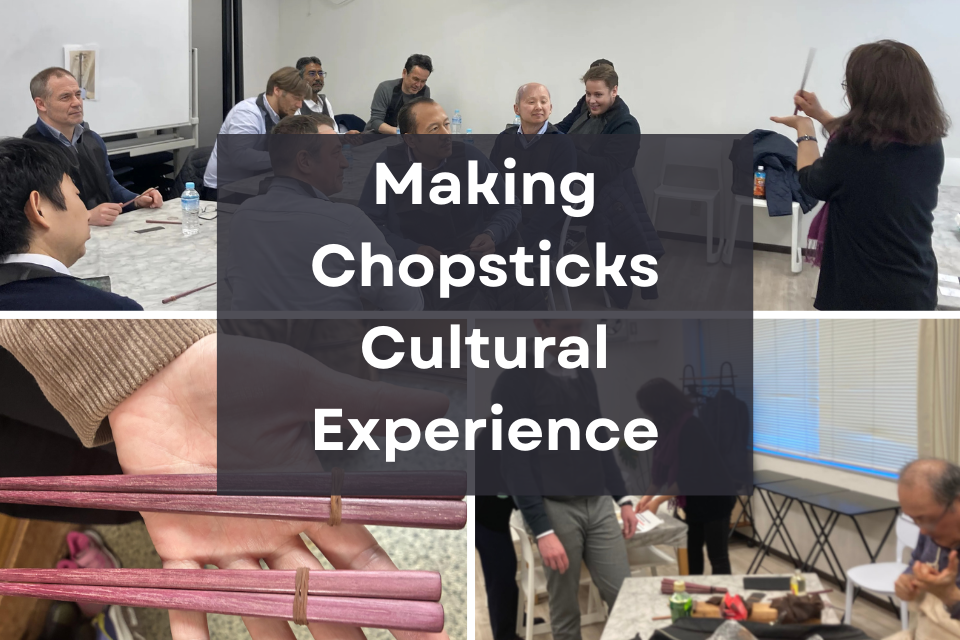
When welcoming important guests from overseas, many hosts face a familiar question. What kind of experience will feel genuinely Japanese, rather than simply well-organized?
Formal sightseeing often fills an itinerary, but it does not always leave room for moments that linger. In settings like these, what tends to be remembered is not the number of places visited, but the pace of the time spent, and how naturally people are able to engage.
This project began with that perspective in mind.
Customer requests and background
Our client’s request was clear. It was to create an experience that feels distinctly Japanese and leaves a lasting impression on overseas guests.
Within a limited stay in Japan, sightseeing and business visits alone often cannot fully convey the depth of Japanese culture and values. The aim was to allow participants to experience these elements directly, through action rather than explanation.
At the same time, the program needed to be accessible to people from different nationalities and cultural backgrounds, enabling them to engage naturally without relying heavily on language.
For this reason, we proposed a traditional chopstick-making experience. Chopsticks are an essential part of everyday life in Japan and quietly reflect craftsmanship, respect for materials, and the mindset of the maker.
They serve as an ideal entry point for experiencing Japanese culture firsthand.
Schedule for the day
- 13:00|Opening
Instructor introduction, participant introductions, and a light icebreaker. - 13:15|Lecture
An introduction to traditional craftsmanship, including stories behind the materials and their cultural background. - 13:30|Crafting Session (Sanding)
Starting from the final process, with personalized guidance from the craftsman. - 14:15|Polishing and Finishing
Final polishing, inspection, and finishing touches. - 15:00|Closing
A discussion on how to use the finished chopsticks, followed by a commemorative photo session.影
Although compact, the program was designed to emphasize focus, calmness, and quiet concentration.
Experience details
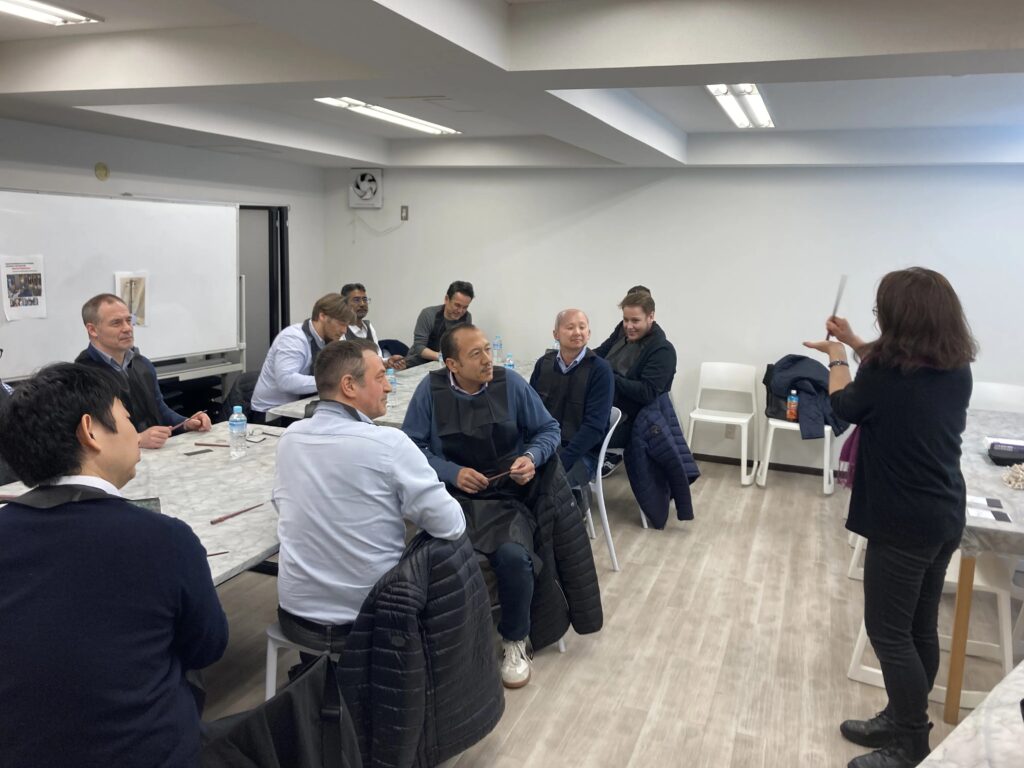
The chopstick-making session drew on ideas shared across Japanese traditional crafts, including those found in Tokyo shamisen making. Rather than focusing on technique alone, attention was placed on how materials are treated, and how each step is carried through to the end.
The wood used, Purpleheart, came from offcuts produced during shamisen construction. Instead of being discarded, these pieces were shaped, sanded, and finished by hand. Natural materials were used throughout the process, including polishing powder and camellia oil.
As the work began, conversation gradually faded. Participants focused on the movement of their hands, adjusting pressure and rhythm as they worked. What started as a simple task became a quiet, concentrated stretch of time.
During progress checks, participants were encouraged to use short Japanese phrases such as “Onegaishimasu(お願いします)” and “Arigatou gozaimashita(ありがとうございました).” These brief exchanges created a natural sense of attentiveness between the craftsman and each participant, without the need for explanation.
Participant reactions and outcomes

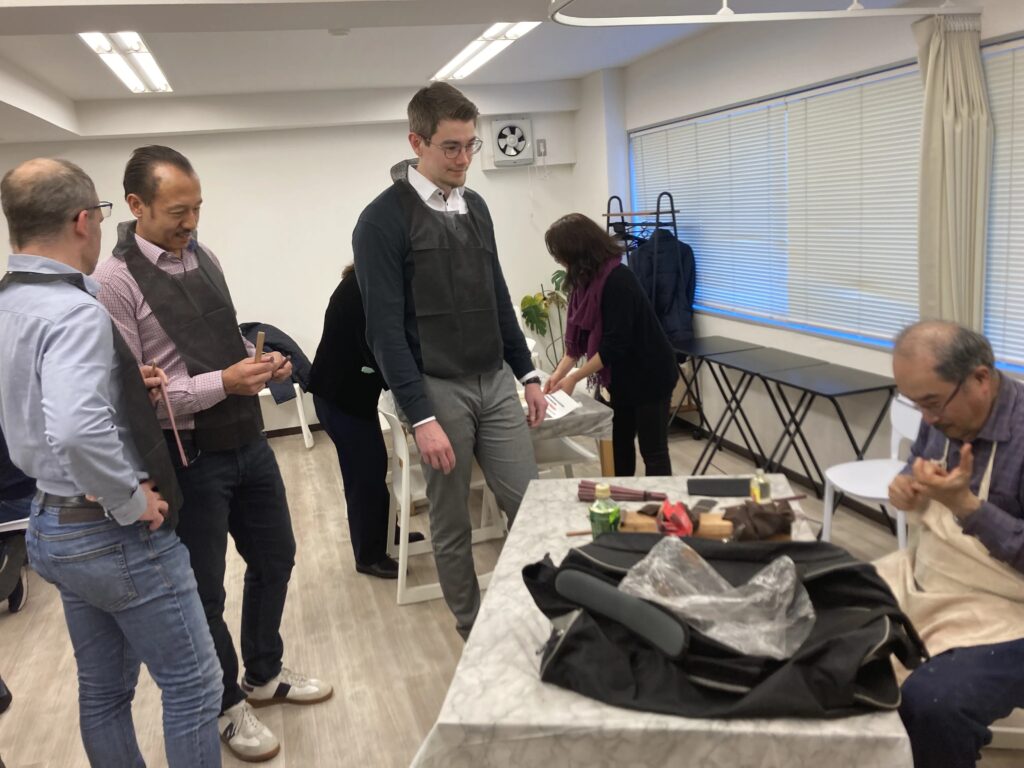
When camellia oil was applied during the final stage, the color of the chopsticks deepened instantly. At the moment the craftsman declared them “passed,” smiles naturally spread across the participants’ faces.
Many described the chopsticks as a wonderful souvenir, and one participant remarked, “I want to use these to eat spaghetti”. Japanese culture, carried naturally into everyday life. This showed that the experience was not perceived as distant or ceremonial, but as something personal and usable.
Participants took home more than a finished product. Through the craftsman’s attitude toward his work, they encountered values long cherished in Japan, including care, patience, perseverance, and quiet pride. Rather than simply learning about Japanese culture, they were able to feel it in a personal and lasting way.
What we can do because we are MOTENAS Japan
In preparation for the program, time was spent speaking directly with the craftsman. These conversations focused not only on technique, but on years of working with the same materials and tools, and the rhythm of daily practice.
On the day of the event, facilitation was kept intentionally light. Rather than filling the session with commentary, space was left for silence, repetition, and observation.
The role was not to explain, but to allow the experience to unfold.
From planning through execution, the same coordinator remained present throughout the experience. This made it possible to adjust timing and guidance based on the atmosphere in the room, rather than following a fixed script.
A one-of-a-kind Japanese cultural experience created from scratch
MOTENAS Japan’s team-building programs are never template-based. Each experience is designed from scratch to reflect the background, purpose, and values of each organization.
Even a vague request such as “We want to host overseas executives, but we don’t know what would be best.” That alone is a sufficient starting point.
Through careful listening, we consider the purpose of the visit, the guest profiles, and what should truly be conveyed within limited time. From there, we curate the most suitable experience.
Building trust beyond language and titles. By connecting with the essence of Japanese culture, understanding grows naturally, and relationships deepen.
MOTENAS Japan aims to transform intentions into meaningful experiences that remain in memory long after the visit has ended.
We are working day and night to spread Japan’s unique hospitality culture to people around the world. Please feel free to contact us for any inquiries regarding the reception and hospitality of guests visiting Japan.


