




Guests who come to us for a karate program almost never ask for a demonstration. They ask who invented it, why Okinawa and not Japan, and what the belts actually mean — usually before they have tied one on for the first time. This article answers those questions, starting with a kingdom that no longer exists.
- Where karate actually originated — and why the answer is Okinawa, not mainland Japan
- Whether the “secret training under a weapons ban” story holds up to modern research
- The three regional roots — Shuri-te, Naha-te, Tomari-te — and which modern styles came from each
- The five masters who shaped karate, from Ankō Itosu in 1901 to Masutatsu Oyama in 1964
- Every major style at a glance: founder, founding year, lineage and what it is known for
- Why karate uses judo’s uniform and belt system, and what the black belt really marks
- Where to see karate history today in Okinawa and Tokyo
What Is Karate? Origins and Evolution
| Period | What happened |
| 14th c. | The Ryukyu Kingdom trades with Ming China; an indigenous method called te is already practiced. |
| 1429 / 1609 | Weapons controls follow Ryukyuan unification, then the Satsuma invasion. |
| 1700s | Distinct forms of Tōdi take shape in the towns of ShuriNaha, , and Tomari. |
| 1901 | Ankō Itosu introduces karate into Okinawa’s public school system. |
| 1922 | Gichin Funakoshi demonstrates karate in Tokyo and stays to teach. |
| 1930s | The written name shifts from 唐手 to 空手; major styles adopt formal names. |
| 1948–70 | The JKA is founded, US servicemen carry karate abroad, and the WKF is established. |
| 2021 | Karate appears as an official Olympic sport at Tokyo 2020. |
Where Did Karate Originate?
Karate originated in Okinawa, then the independent Ryukyu Kingdom, not in mainland Japan. It grew from an indigenous practice called te (手, “hand”) combined with Chinese fighting methods that arrived through trade with Fujian province from the late fourteenth century.
The Ryukyu Kingdom governed Okinawa from 1429 until Japan annexed it in 1879, and it lived on trade. From 1392 a community of Chinese settlers at Kumemura, near Naha, kept a permanent channel open to Fujian. Methods travelling along that channel merged with te, and the hybrid took the name Tōdi (唐手, “Tang hand”), with Tang standing for China. By the eighteenth century Tōdi was practiced widely enough among the kingdom’s officials to have developed regional differences.
Did Okinawan Farmers Really Invent Karate in Secret?
Mostly no. The people who trained were overwhelmingly the pechin, a hereditary class of officials and warriors who staffed the royal government and its policing duties — not farmers. Training was private rather than secret, and the weapons bans were real but far less absolute than the popular story suggests.
That story is worth stating plainly, because it is repeated almost everywhere: weapons were banned, so unarmed islanders trained by moonlight, turning farm tools into weapons and their bodies into a last line of defense. Parts of it are true. King Shō Shin centralized control of weapons in the early sixteenth century, and after the Satsuma domain invaded in 1609 the administration imposed further restrictions.
What modern research qualifies is who was involved and how secretly. The pechin were a professional class with police and guard duties, for whom martial skill was an occupational requirement rather than a clandestine resistance. The Satsuma-era controls were loosely enforced, and Ryukyuan officials continued to carry and train with weapons throughout the period. Transmission ran teacher to student and within families — the normal pattern for premodern martial traditions anywhere, not evidence of concealment.
The moonlight version has lasted because it is a better story. A disarmed people resisting through discipline alone travelled extremely well through a century of underdog cinema, and it gave karate a moral origin that a bureaucratic one lacks. Knowing the difference does not diminish the art; it places it more precisely, as the professional skill of a small administrative class in a kingdom that had to negotiate with much larger neighbors. The related claim that karate descends from the Indian monk Bodhidharma at the Shaolin Temple belongs to the same category — legend has it so, but no historical evidence supports it.
What Is the Difference Between Shuri-te, Naha-te, and Tomari-te?
Shuri-te, Naha-te, and Tomari-te are the three regional lines of Okinawan karate, named after the towns where they were taught. Shuri-te favours long stances and direct, linear attacks; Naha-te favours close range, circular deflection, and controlled breathing; Tomari-te sits between the two.
Shuri-te grew up around the royal capital, where the court and its officials lived, and its best-known teacher was Sōkon Matsumura (c. 1809–1899), bodyguard to the Ryukyuan kings. Naha-te developed in the port district, where contact with Fujian traditions was most direct, and was transmitted above all by Kanryō Higaonna (1853–1915). Tomari-te came from a smaller harbor town and never produced a large modern school, though its kata survive inside those that did.
This map explains the family tree of every modern style. Shuri-te runs forward into Shotokan and Shōrin-ryū; Naha-te into Gōjū-ryū; and Shitō-ryū exists because Kenwa Mabuni trained seriously in both and refused to choose.
Why Is Karate Called “Empty Hand”?
Karate was originally written 唐手, “Tang hand,” acknowledging its Chinese influence. In the 1930s the first character was replaced with 空, “empty” — pronounced identically in Japanese — giving 空手, “empty hand.” The change reflected both the fact that karate uses no weapons and a political climate in which a reference to China had become unwelcome.
That renaming was part of a wider move to the mainland. In 1901 Ankō Itosu placed karate on the physical education curriculum at Shuri Jinjo Elementary School, turning an art transmitted person to person into one with classes and a syllabus. Gichin Funakoshi demonstrated in Tokyo in 1922 and stayed on to teach; Kenwa Mabuni moved to Osaka in 1929. Funakoshi also borrowed judo’s uniform and belt ranks and pushed the suffix -dō (道, “way”), presenting karate as a path of self-cultivation that Japanese institutions would recognize.
How Did Karate Spread Around the World?
Karate spread globally along two routes after World War II American servicemen stationed in Okinawa who trained locally and opened schools at home, and Japanese instructors sent abroad deliberately by newly formed federations.
Isshin-ryū and Uechi-ryū reached the United States largely by the first route. The second was institutional — the Japan Karate Association, founded in 1949, dispatched Shotokan teachers to Europe and the Americas from the late 1950s, and many never came back. The World Karate Federation, founded in 1970, gave the sport one set of competition rules, and by the 1980s cinema was doing the rest.
Who Inrate? Thvented Kae Five Masters Who Shaped It
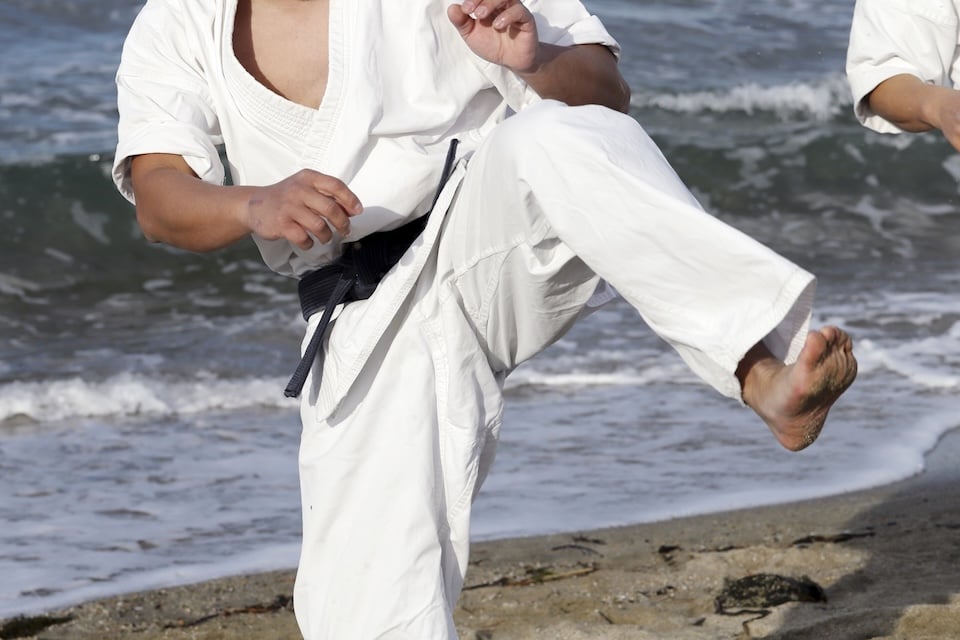
No single person invented karate — it developed over centuries — but five teachers made the specific decisions that produced the art as it is practiced today. The lineages are easy to follow. Ankō Itosu taught Gichin Funakoshi, who took karate to Tokyo. Kanryō Higaonna taught Chōjun Miyagi, who formalized the Naha-te line. Kenwa Mabuni trained under both Itosu and Higaonna. Masutatsu Oyama arrived a generation later and pushed karate in a direction none of them had chosen.
Ankō Itosu (糸洲安恒, 1831–1915)
Born in Shuri to a pechin family and a student of Sōkon Matsumura, Itosu’s contribution was pedagogical. In 1901 he persuaded Okinawan authorities to admit karate to the school curriculum, and to make it teachable to children he created the five Pinan kata (Heian in Japanese styles), simplifying older forms such as Kusanku. His 1908 Ten Precepts argued that karate belonged in public education. The idea that karate can be taught systematically to a class of beginners begins with him.
Gichin Funakoshi (船越義珍, 1868–1957)
A schoolteacher from Shuri and a student of Itosu, Funakoshi demonstrated Okinawan karate in Tokyo in 1922 and did not return home, teaching instead at universities across the capital. He wrote the first widely read books on the subject, promoted the change in written name, and adopted judo’s uniform and ranking system, letting karate fit into Japan’s martial arts institutions. His students founded the Shotokan line, named after his pen name Shōtō.
Chōjun Miyagi (宮城長順, 1888–1953)
Born in Naha, Miyagi was the principal successor to Kanryō Higaonna’s Naha-te. He travelled to Fujian in 1915 to study the Chinese sources of his teacher’s art at first hand, developed the Gekisai forms as introductory material, and gave Sanchin its central place in training. Gōjū-ryū (“hard-soft style”) was registered around 1933, and he taught in Hawaii in 1934 — among the earliest sustained efforts to teach karate outside Japan.
Kenwa Mabuni (摩文仁賢和, 1889–1952)
Born in Shuri on 14 November 1889, Mabuni began training with Itosu at thirteen and later studied Naha-te under Higaonna — one of the few teachers of his generation to work both lineages in depth. He moved to Osaka in 1929 and in 1934 named his system Shitō-ryū, combining the first characters of his two teachers’ names. His preoccupation was preservation: Shitō-ryū carries the largest kata syllabus of any major style, functioning as an archive of Okinawan practice.
Masutatsu Oyama (大山倍達, 1923–1994)
Born in Korea in 1923, Oyama moved to Japan as a teenager and trained in Shotokan and later Gōjū-ryū. Known for solitary mountain training in the late 1940s and demonstrations against bulls, his lasting contribution was structural: he rejected the non-contact competition format and built a style around full-contact bare-knuckle sparring. The Kyōkushin organization he founded in 1964 became one of the largest karate bodies in the world.
What Are the Main Styles of Karate?
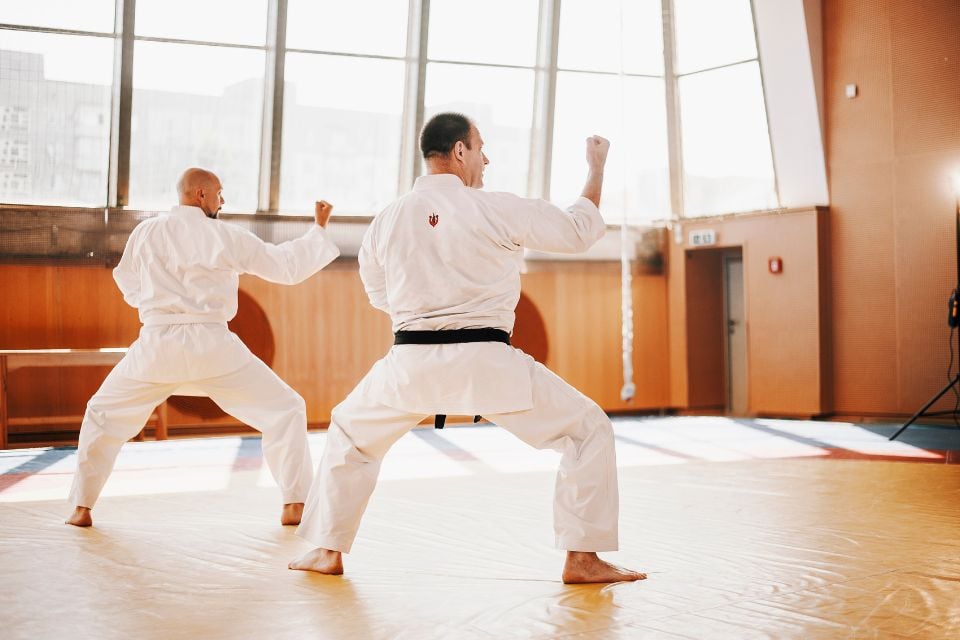
The four main styles of karate are Shotokan, Gōjū-ryū, Shitō-ryū, and Wadō-ryū, all formalized in the 1930s. Kyōkushin, founded in 1964, is the largest of the later full-contact styles, and Okinawa additionally recognizes Uechi-ryū and Shōrin-ryū as principal traditional schools.
A style, or ryūha, is a named line of transmission: a founder, a kata syllabus, and preferences about distance, stance, and contact. Most acquired formal names in the 1930s, when the Dai Nippon Butoku Kai required martial arts groups to register.
Shotokan: the most practiced style worldwide
Shotokan descends from Funakoshi’s Shuri-te and took its mature form in Tokyo in the 1930s: long, low stances, linear techniques, heavy emphasis on kihon. The JKA instructor programme placed full-time teachers in dozens of countries from the late 1950s, making it the default introduction to karate worldwide.
Kyōkushin: full-contact power and spirit
Kyōkushin (極真, “ultimate truth”), founded by Oyama in 1964, draws on both Shotokan and Gōjū-ryū. Competition is bare-knuckle and full-contact — head strikes excluded, matches decided by knockdown — and its rule set shaped most later knockdown karate.
Enshin: sabaki method and circular defense
Enshin was founded by Joko Ninomiya in 1988, after he had competed at a high level in Kyōkushin. It keeps full-contact rules but reorganizes them around sabaki: stepping off the line of attack, redirecting force, finishing from the blind angle. Its Sabaki Challenge has drawn international entrants since 1989.
| Style | Founder (founded) | Root lineage and character |
| Shotokan | Gichin Funakoshi (1930s) | Shuri-te — long stances, linear committed techniques |
| Gōjū-ryū | Chōjun Miyagi (c. 1930) | Naha-te — hard-soft contrast, regulated breathing |
| Shitō-ryū | Kenwa Mabuni (1934) | Shuri-te + Naha-te — largest kata syllabus of any major style |
| Wadō-ryū | Hironori Ōtsuka (1939) | Shuri-te + jujutsu — body shifting, evasion, throws |
| Kyōkushin | Masutatsu Oyama (1964) | Shotokan + Gōjū-ryū — full-contact knockdown competition |
What Are Kobudo and Kenpo?
Kobudo (古武道) is Okinawa’s weapon tradition — the bō staff, sai, tonfa, nunchaku, and kama — which developed alongside karate, with many teachers training in both. Kenpo (拳法) is the Japanese reading of the Chinese quanfa, “fist method,” and labels several loosely related systems rather than one.
The kobudo implements are often described as repurposed farm tools, though several were purpose-built or drawn from Chinese arms. Technically the two traditions share the same body mechanics: the weapon extends the movement rather than replacing it. Kenpo reached the United States by a route separate from karate — James Mitose taught in Hawaii in the 1940s, and Ed Parker developed American Kenpo from that line — producing arts that overlap with karate historically without descending from any single Okinawan school.
Kata, Kumite, and the Belt System
Kata (型) are fixed sequences of techniques performed against imagined opponents. Styles share them because, before karate had a written curriculum, kata were the curriculum — the medium through which a teacher transmitted an entire system, so forms inherited from a common source survive in schools that otherwise look nothing alike.
That is why kata names preserve Chinese readings, and why Sanchin or Kusanku appear across unrelated styles. Applications were often explained only to senior students; the study of those hidden applications is called bunkai. Itosu’s Pinan forms, created around 1905 for schoolchildren, sit at the other end of the spectrum — deliberately simplified, and now the most widely practiced kata in the world.
What Is Kumite in Karate?
Kumite (組手, “meeting of hands”) is karate sparring, ranging from fixed prearranged partner drills to free sparring. Its modern forms are twentieth-century: prearranged kumite was formalized on the mainland in the 1920s and 1930s, competitive free sparring after the war. The split that still defines karate competition dates from the same period — point sparring on one side, knockdown rules on the other.
Where Did the Karate Belt System Come From?
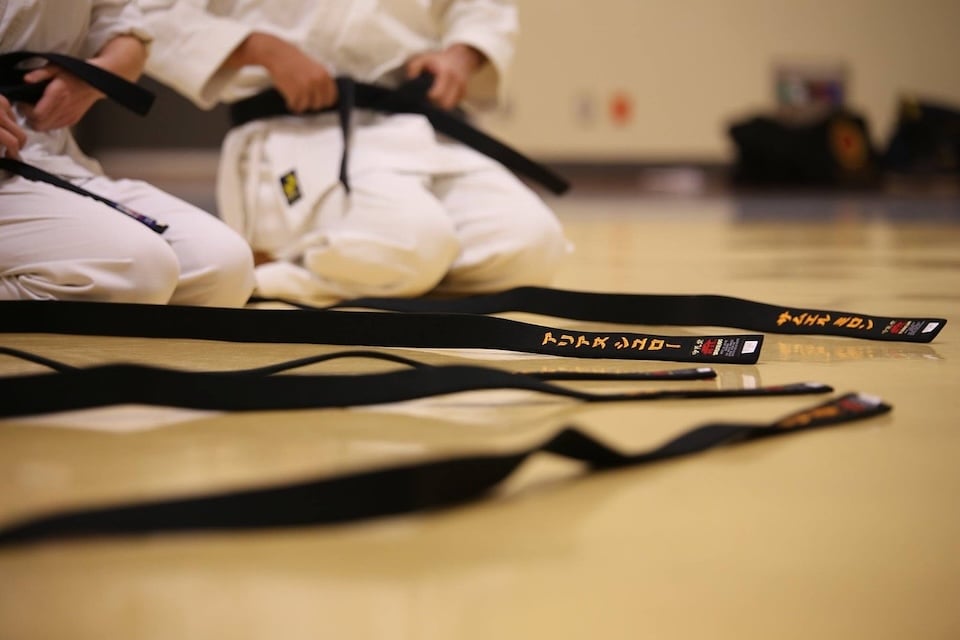
The karate belt system came from judo, not Okinawa. Jigoro Kano introduced the kyū–dan grading system to judo in the 1880s, and Funakoshi adopted it — along with the white karategi and the belt itself — in the 1920s, as part of presenting karate in a form mainland institutions would recognize.
Coloured intermediate belts were a later European addition that spread back into Japanese arts, which is why the sequence varies between organizations. The adoption matters historically because it marks the moment karate stopped being a private transmission and became an institution with examinations and a hierarchy outsiders could read. The black belt marks competence in the fundamentals, not an endpoint. The same inheritance is visible in any first class: a standing bow, warm-ups leading into kihon counted aloud in Japanese, then a simple kata or partner drill, all barefoot — the school-hall format Itosu and Funakoshi built a century ago, still running.
What Are the Benefits of Practicing Karate?
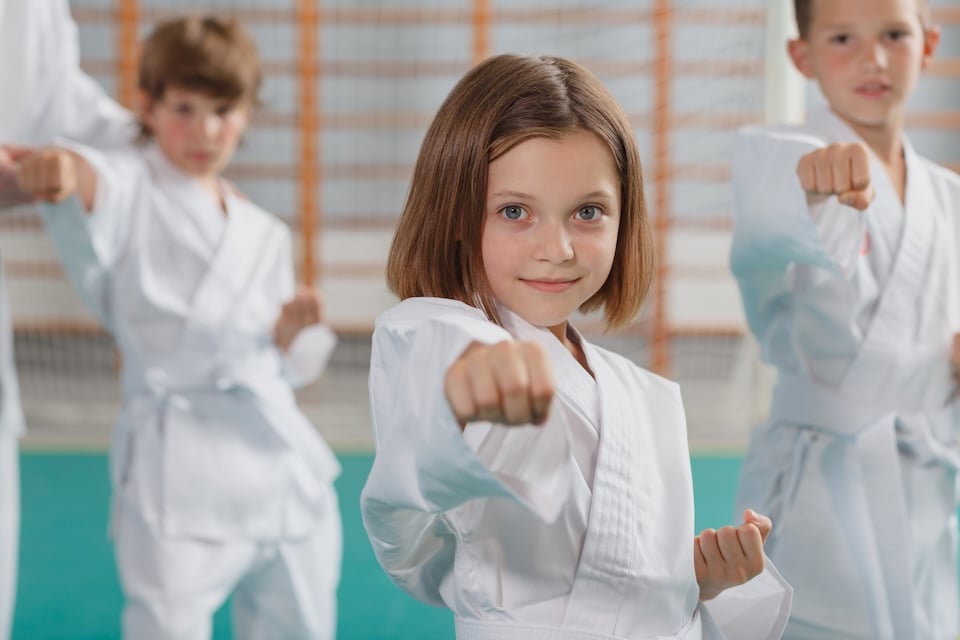
Karate builds a practical response to physical threat — awareness of distance, composure under pressure, techniques that work without size or strength advantages — and combines cardiovascular effort, muscular endurance, balance, and flexibility, with progress measured in skill rather than load.
The less obvious benefits are the ones karate is valued for in Japan. The rituals of the dojo — bowing on entry, arriving on time, repeating a basic movement long after it feels productive — are a structured lesson in patience and self-control. A dojo is also one of the few places where a beginner and a thirty-year practitioner train side by side, and where seniority carries an obligation to teach — part of why karate adapts so readily to schools, workplaces, and team settings.
Is Karate an Olympic Sport?
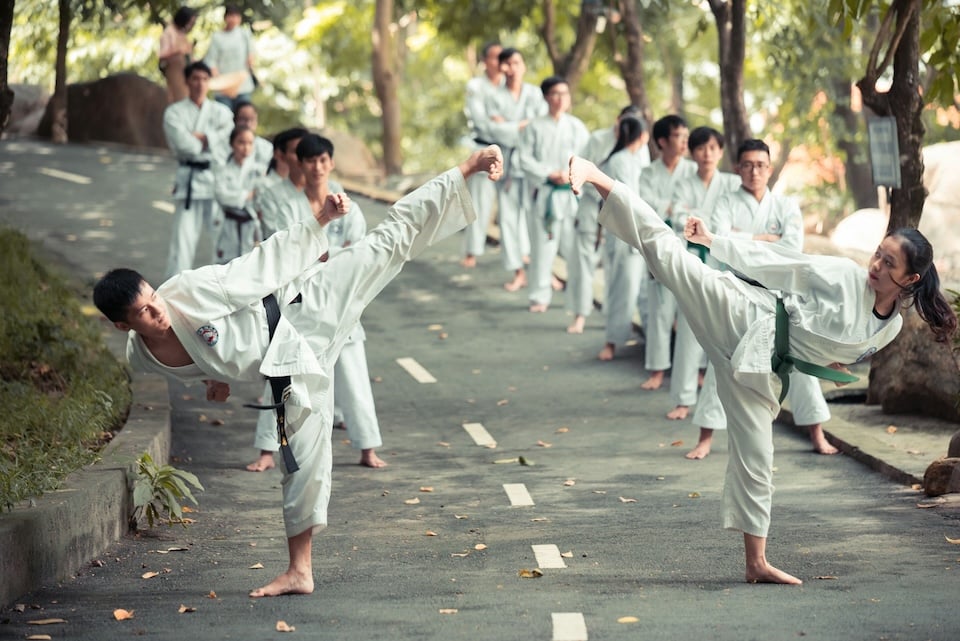
Karate is not currently an Olympic sport. It appeared once, at the Tokyo 2020 Games held in 2021, with eight gold medals across kata and kumite, but was absent from Paris 2024 and is not on the programme for Los Angeles 2028. The World Karate Federation continues to campaign for Brisbane 2032.
Ryo Kiyuna won kata gold for Japan and Sandra Sánchez the women’s title for Spain. The debut still standardized rules across a fragmented sport and raised the profile of athletes who had trained for decades in obscurity. Karate’s other institutional track advanced independently, with Okinawa Prefecture pursuing recognition of its karate as intangible cultural heritage — an inheritance to preserve rather than a sport to optimize.
Where to Experience Karate History Today
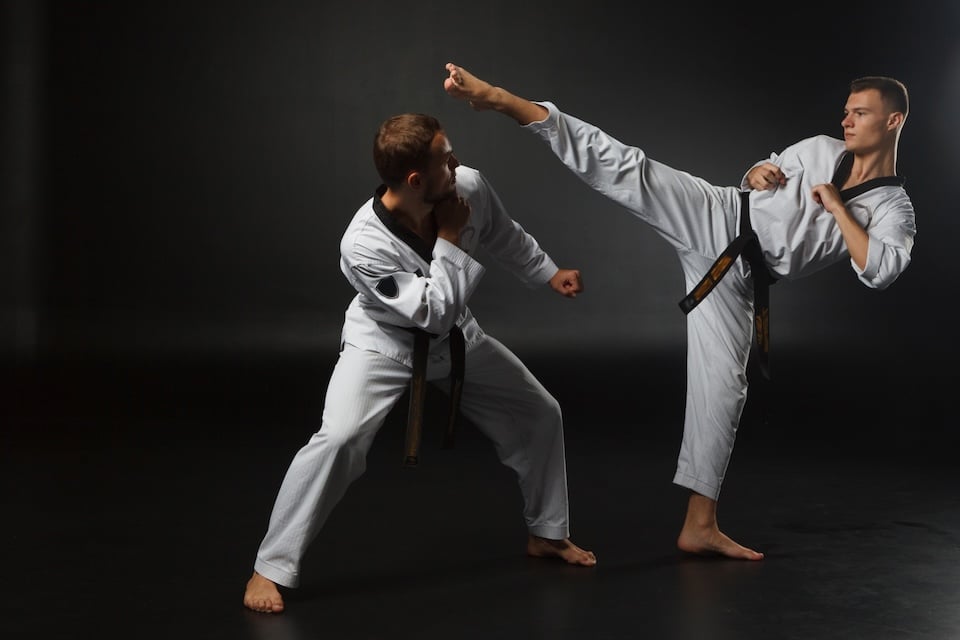
Okinawa: the birthplace
Okinawa is where karate’s history is most legible on the ground. The Okinawa Karate Kaikan in Tomigusuku, opened in 2017, combines an exhibition hall tracing the art from Tōdi to the present with working training halls and a special dōjō used for senior grading examinations. Shuri is the other essential stop — the district where the pechin class lived and trained, and where Matsumura, Itosu, and Funakoshi all learned.
Dojos in Tokyo
Tokyo holds the institutions that took karate global. The JKA Headquarters Dojo in Bunkyo is the home of the Japan Karate Association. The Kyōkushin Honbu Dojo in Ikebukuro is Oyama’s original base. The Tokyo Sumida Dojo, near Ueno-Okachimachi, runs sessions for beginners and international visitors — the practical option for anyone who wants to train rather than observe.
Books, seminars, and international events
Funakoshi’s Karate-Dō: My Way of Life is the closest thing to a memoir of karate’s move to the mainland, and his Karate-Dō Kyōhan sets out the syllabus as he taught it. The Bubishi, a Chinese manual that circulated among Okinawan teachers in manuscript and influenced both Miyagi and Mabuni, exists in an annotated English translation by Patrick McCarthy.
The living transmission happens at gatherings: seminars of one or two days on a narrow subject, and multi-day camps, gasshuku, of three to seven. At international level the WKF World Championships and the Okinawa-hosted festivals draw practitioners from every continent, and many Japanese dōjō accept short-term visitors by prior arrangement.
Custom Karate Experiences with MOTENAS JAPAN
MOTENAS JAPAN designs karate programs for corporate and incentive groups visiting Japan, built around the history above rather than a generic fitness session: a cultural introduction, group warm-ups, fundamental techniques, synchronized kata, and supervised board-breaking, led by champion-level black belts. Venues range from a traditional dōjō to a conference hall or outdoor setting in Tokyo, Kyoto, or a resort destination, with coordination, interpretation, photography, and travel logistics handled end to end.
Frequently Asked Questions
- Who invented karate?
-
No single person. Karate developed over centuries in the Ryukyu Kingdom. Ankō Itosu made it teachable and brought it into schools in 1901; Gichin Funakoshi carried it to mainland Japan in 1922.
- Is karate from China or Japan?
-
Both, in sequence. Karate took shape in Okinawa — an independent kingdom at the time — from local methods combined with Chinese ones, and became a Japanese martial art only after Okinawa was annexed in 1879 and karate reached the mainland in the 1920s.
- How old is karate?
-
The practice called te is documented in Okinawa by the fourteenth century, and regional schools existed by the 1700s. Karate in its modern form dates from 1901 onward. The roots are roughly six centuries old; the modern art is around a hundred.
- What are the four main styles of karate?
-
Shotokan, Gōjū-ryū, Shitō-ryū, and Wadō-ryū. All four were formalized in Japan in the 1930s. Okinawa separately recognizes Uechi-ryū and Shōrin-ryū among its principal traditional styles.
- What is the oldest style of karate?
-
No modern style is the oldest, since all were named in the twentieth century. The oldest continuous lines are the Okinawan ones — Shōrin-ryū from Shuri-te and Gōjū-ryū from Naha-te — whose kata predate the style names by generations.
- Did karate come from Shaolin and Bodhidharma?
-
Legend has it so, but there is no historical evidence. The story links all Asian martial arts to a single Indian monk at the Shaolin Temple. Karate’s documented Chinese influence came much later and much more specifically, from Fujian province through Ryukyuan trade.
- Why is karate called “empty hand”?
-
Because the first character of 唐手 (“Tang hand”) was swapped in the 1930s for 空 (“empty”), a homophone in Japanese. The new writing described an unarmed art and removed a reference to China that had become politically awkward.
- Where can I see karate history in Japan?
-
Okinawa, above all: the Okinawa Karate Kaikan in Tomigusuku and the Shuri district. In Tokyo, the JKA Headquarters Dojo and the Kyōkushin Honbu Dojo are the institutions that carried karate abroad.
Why Karate’s Story Still Matters Today
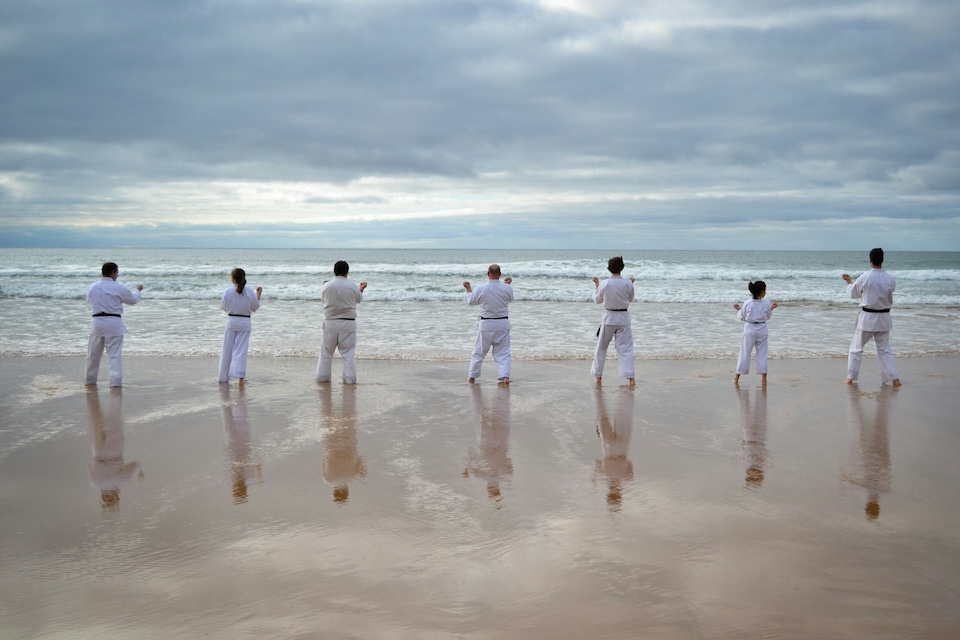
Read as a whole, karate’s history is a story of adaptation. A small kingdom’s officials absorbed methods from a larger neighbour and made them their own. A private transmission became a school subject when the political ground shifted. An Okinawan practice took on Japanese dress, name, and ranking to survive on the mainland, then rebuilt itself as a sport and a cultural heritage. At every turn karate kept its core and changed its form — which is why it is still here.
That pattern is recognizable well outside the dōjō, which is one reason karate translates so readily into a group setting. MOTENAS JAPAN builds its programs on that idea — historical context alongside hands-on practice under champion-level black belts, with venue, interpretation, and logistics handled end to end.
If you are planning a corporate visit, an incentive program or a cultural event in Japan and want karate to be more than a demonstration, we would be glad to help you shape it. Contact us below and tell us what you have in mind.
We are working day and night to spread Japan’s unique hospitality culture to people around the world. Please feel free to contact us for any inquiries regarding the reception and hospitality of guests visiting Japan.


