





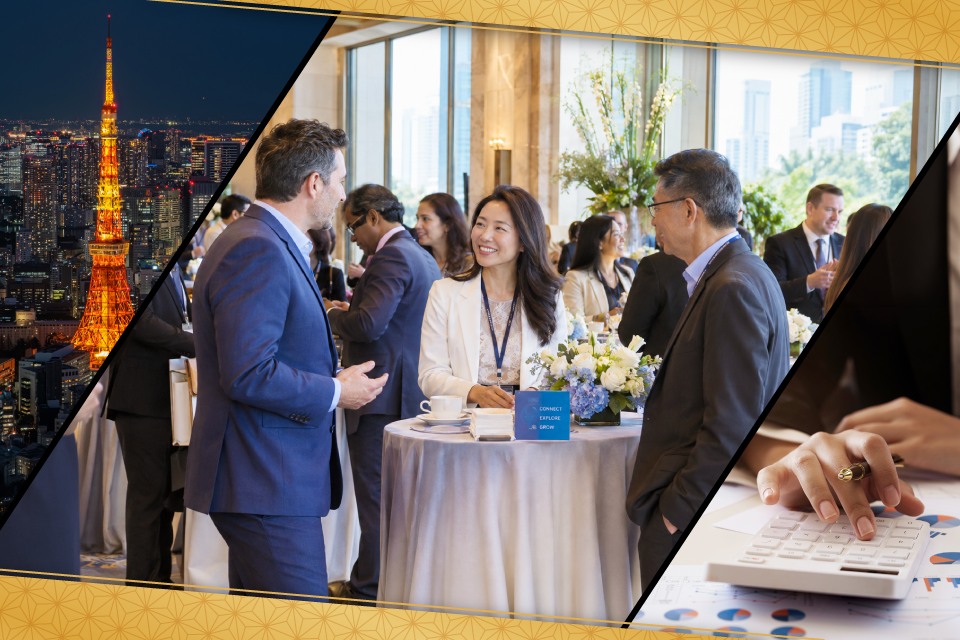

Based on publicly available 2026 rates, a corporate event in Tokyo can cost roughly ¥5,000 to ¥35,000+ per person, depending on the venue type, group size, and program.
Your final budget may also include costs that are easy to overlook, such as service charges and consumption tax. This guide breaks down the major cost categories so you can build a more realistic budget before requesting quotes.
All prices in this guide reflect publicly available rates for 2026 and are intended as planning benchmarks. Actual costs vary by venue, season, and specific requirements.
(Last updated: September 2026)
- How much a corporate event in Tokyo typically costs per person
- What is usually included—and excluded—in a corporate event budget
- What to expect for venue rental and hotel meeting package costs in Tokyo
- How much to budget for food, beverages, interpretation, and bilingual support
- What chartered transportation and private car services can add to your budget
- Which factors affect the cost of entertainment and cultural experiences
- How to estimate a realistic budget for events with 20, 50, or 100 participants
Quick Answer: Corporate Event Costs at a Glance
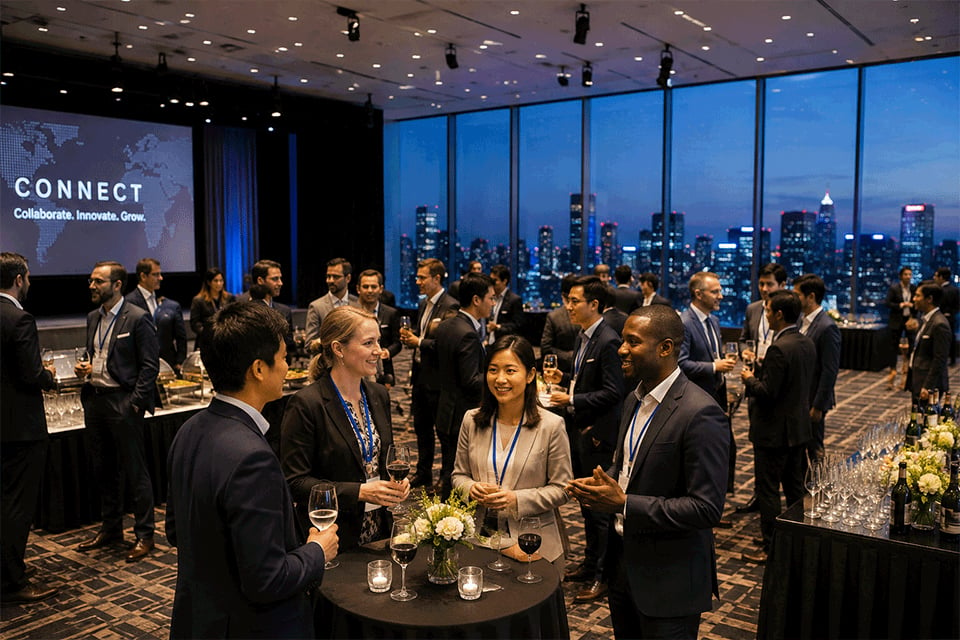
Corporate event costs in Tokyo vary widely depending on the venue, event format, food and beverage requirements, and level of production. As a practical benchmark, banquet plans may start at around ¥10,000–¥15,000 per person, while hotel event packages can range from approximately ¥26,000–¥33,000 per person.
The figures below are planning benchmarks based on the actual price examples introduced later in this article, rather than fixed market rates or package prices. Additional requirements such as interpretation, private transportation, specialized entertainment, AV equipment, and event production may increase the total cost.
| Event Type | Estimated Cost per Person | Typical Uses |
| Banquet / Reception Plans | ¥10,000–¥15,000+ | Business dinners, networking receptions, internal gatherings |
| Hotel Event Packages | ¥26,000–¥33,000+ | Corporate meetings, seminars, executive events, formal receptions |
| Customized / Premium Events | Varies by requirements | Product launches, gala dinners, cultural programs, large-scale or high-end events |
For initial planning, the per-person figure is most useful as a benchmark rather than a final budget. A 50-person event does not necessarily cost exactly five times as much as a 10-person event because venue rental, equipment, interpretation, transportation, and entertainment may be priced per room, vehicle, interpreter, or performance rather than per guest.
MOTENAS JAPAN has supported corporate and international programs that combine business requirements with cultural experiences and on-site coordination. Later sections break down the major cost categories individually so you can see where the budget goes and which expenses may sit outside the headline per-person rate.
What’s Included in “Corporate Event Cost” in Tokyo
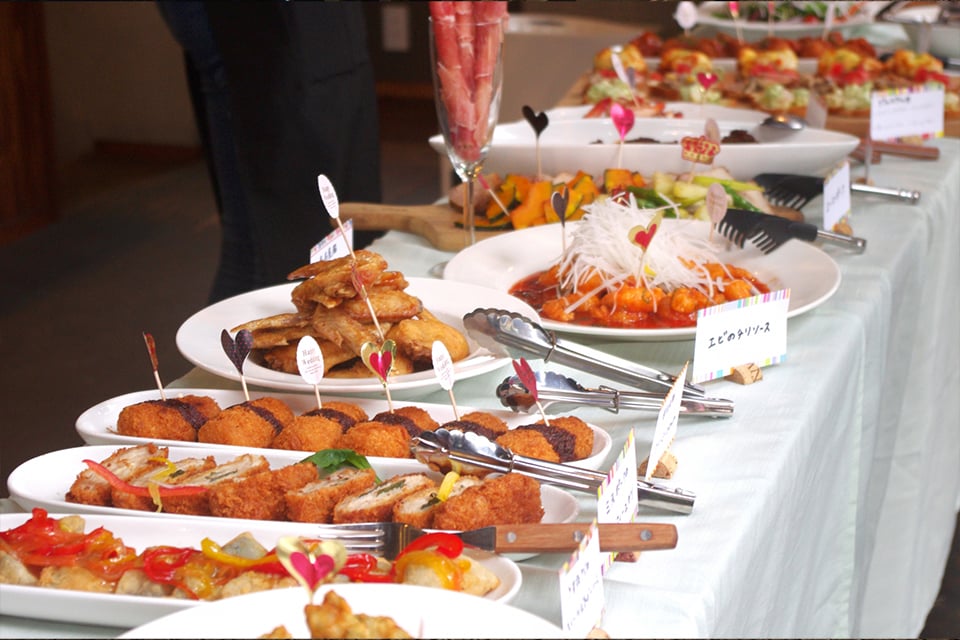
A corporate event budget in Tokyo typically includes six core categories: venue rental, food and beverage, interpretation or bilingual support, transportation, entertainment or production, and applicable taxes and service charges. However, what appears in a proposal depends on the venue and suppliers involved, so confirm the scope before comparing quotes.
- Venue: Meeting rooms, banquet spaces, reception venues, setup time, and required equipment
- Food and beverage: Lunches, dinners, receptions, coffee breaks, and beverage packages
- Interpretation and bilingual support: Interpreters, bilingual event staff, and language support required during the program
- Transportation: Chartered buses, private vehicles, airport transfers, and other group transportation
- Entertainment and cultural experiences: Performers, instructors, production requirements, and activity-related arrangements
- Taxes and service charges: Consumption tax and any service charges applied by the venue or supplier
Accommodation, international airfare, and corporate gifts or branded merchandise are often budgeted separately rather than included in the core event cost. If your program requires these items, clarify whether the planner will include them in the main proposal or present them as separate expenses.
The distinction matters when comparing proposals. A lower headline price may simply exclude transportation, language support, production, or other services included in another quote. Compare the scope and assumptions behind each figure—not just the final total—to understand what your Tokyo corporate event will actually cost.
Venue Rental: What You’ll Actually Pay

For a corporate event in Tokyo, venue costs can range from relatively low hourly meeting-room rates to hotel packages priced at more than ¥30,000 per person. The meaningful number is not always the room rental itself: catering, audiovisual equipment, staffing, service charges, and consumption tax can materially change the final venue bill.
For a current hotel benchmark, ANA InterContinental Tokyo lists meeting packages for 10–90 delegates at ¥26,000 per person for a half-day plan with lunch and ¥33,000 per person for a full-day plan with lunch. The half-day package covers up to four hours, while the full-day package covers up to eight hours. Both include the meeting venue, lunch, coffee or tea breaks, basic audiovisual equipment, and meeting stationery. Importantly, these published package prices already include consumption tax and the service charge.
| Venue Option | Published / Reference Cost | What to Check |
| Hourly meeting room | Around ¥3,000–¥16,000/hour* | Capacity, AV equipment, setup time, and overtime |
| Hotel half-day package | ¥26,000/person | Up to 4 hours, lunch and one coffee/tea break included |
| Hotel full-day package | ¥33,000/person | Up to 8 hours, lunch and AM/PM coffee or tea breaks included |
Service Charges and Consumption Tax
When a venue quotes a net price rather than an all-inclusive package, check the service charge and consumption tax before comparing it with another proposal. Japan Meetings reports service charges of roughly 10%–15% at Japanese venues, with 10% consumption tax commonly applied after the service charge. Under that structure, a ¥100,000 base amount could become approximately ¥121,000–¥126,500, depending on the service-charge rate.
Food and Beverage Minimum Spend
Another issue is the food-and-beverage (F&B) minimum spend. Some venues require your event to meet a minimum catering commitment based on the space, date, and event size. A room that appears affordable on its own may therefore have a substantially higher effective minimum once catering requirements are included.
Overtime and How Venue Hours Are Counted
Finally, confirm exactly when your contracted venue time begins and ends. Setup, rehearsals, extended event hours, and overtime can appear as additional charges rather than being included in the base rental. The safest comparison is therefore the gross event-space cost for the hours you actually need—not simply the advertised room rate.

Food & Beverage: Banquets and Receptions
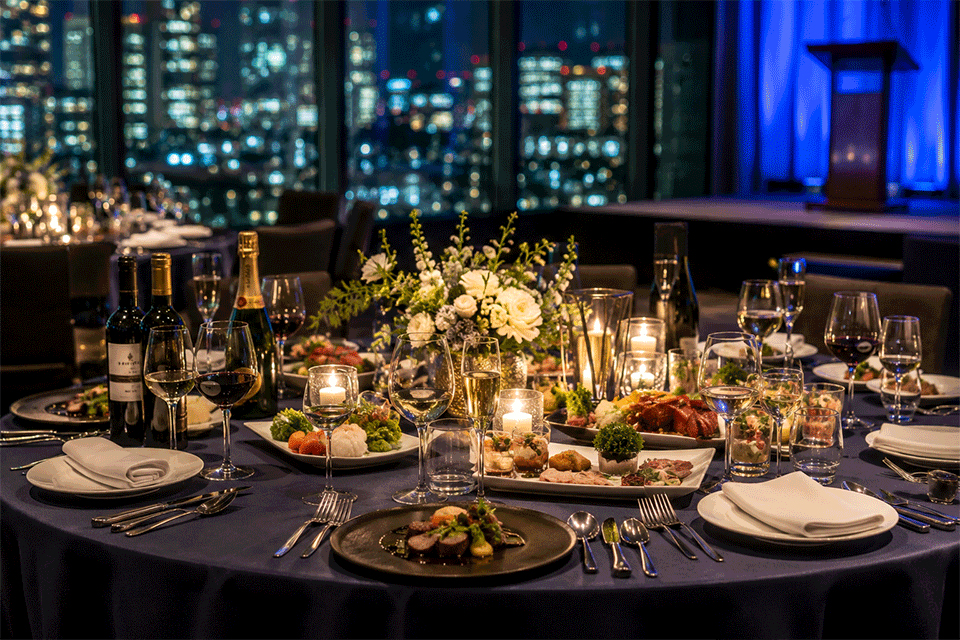
For corporate banquets and receptions in Tokyo, a practical starting point is around ¥10,000–¥15,000 per person for a hotel party plan with food and free-flow drinks. Current published Tokyo hotel plans support this range: Imperial Hotel Tokyo lists a cocktail buffet at ¥15,000 per person, while Tokyo Dome Hotel lists a 2026 party plan at ¥10,000 per person with a buffet and free-flow beverages.
| Food & Beverage Style | Budget Reference | Typical Format |
| Corporate party / reception | ¥10,000–¥15,000 per person | Buffet or course meal with free-flow drinks |
| More formal dining | ¥15,000+ per person | Seated courses, upgraded menus, or more formal service |
| Premium Japanese dining | Around ¥20,000+ per person | Higher-end kaiseki or Japanese dining; venue and private-room charges may be separate |
The important point is to compare what the quoted per-person rate actually includes. For example, Imperial Hotel Tokyo’s ¥15,000 cocktail buffet includes food, drinks, room rental, and basic audiovisual equipment, while other venues may quote the meal separately from the room, beverages, or equipment. When reviewing a proposal, check the meal format, beverage package and duration, room charge, service charge, consumption tax, and minimum guest requirements.
For formal Japanese dining, costs can move higher depending on the menu and setting. As a current benchmark, Hotel Chinzanso Tokyo lists a ¥20,000 per-person Japanese dining plan that includes the meal, service charge, and consumption tax, while private-room use is charged separately. Compare the all-in food and beverage cost for the format you need rather than the menu price alone.
Interpretation & Bilingual Support Costs

For a full day in Tokyo, professional Japanese-English interpretation can range from about ¥50,000 to ¥170,000 per interpreter, depending on experience, specialization, and interpretation mode. Current 2026 Tokyo benchmarks place senior Tier A interpreters at ¥110,000–¥130,000 per full day, while Tier S conference specialists can reach ¥130,000–¥170,000. General corporate or liaison-level support starts lower.
| Interpretation Level | Full-Day Cost per Interpreter | Typical Use |
| Tier S — Conference / Specialized | ¥130,000–¥170,000 | Simultaneous interpretation, specialized conferences, high-stakes sessions |
| Tier A — Senior Specialist | ¥110,000–¥130,000 | Technical meetings, executive discussions, specialist subjects |
| Tier B — Corporate | ¥85,000–¥110,000 | General business meetings and consecutive interpretation |
| Tier C — Liaison / Attendant | ¥50,000–¥70,000 | Event support, guest assistance, and general liaison |
Source: Osaka Language Solutions, Japanese Interpreter Pricing Snapshot: 2026 Core Rates, Specialties, and Regional Indexing
Half-Day Interpretation Rates
Half-day rates are lower but are not simply half of a full-day fee. The same 2026 Tokyo rate card lists up-to-four-hour rates of approximately ¥35,000–¥50,000 for Tier C, ¥59,000–¥77,000 for Tier B, ¥77,000–¥91,000 for Tier A, and ¥91,000–¥115,000 for Tier S.
Team Requirements for Simultaneous Interpretation
Simultaneous interpretation should be budgeted differently because the cost is based on an interpreter team rather than a single person. For sustained simultaneous assignments, two or more interpreters typically rotate during the session. This means that even two Tier A interpreters at the lower end of the published full-day range would start at approximately ¥220,000 per day, before equipment, travel, or other associated expenses.
Choosing the Right Level and Requesting a Quote
The required level also matters. A straightforward internal meeting may only require consecutive interpretation or bilingual event support, while a technical presentation, executive conference, or specialized industry session can require more experienced interpreters and advance preparation.
When budgeting, define the role before asking for an interpreter quote. Specify whether you need consecutive or simultaneous interpretation, the working languages, session duration, subject matter, number of participants, and whether specialized terminology will be used. This gives suppliers enough information to recommend the appropriate level of support instead of pricing every event as the same type of assignment.
Transportation: Chartered Vehicles and Private Cars
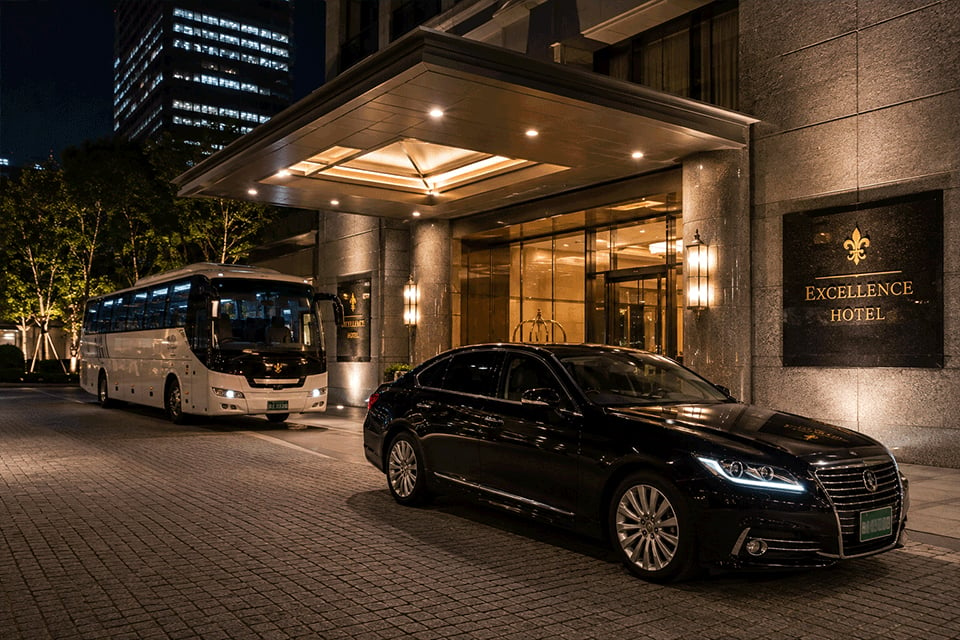
For group transportation in Tokyo, a Toyota Coaster-class microbus for up to 18 passengers can cost around ¥100,000–¥125,000 or more for up to 10 hours, while private car services commonly fall in the US$230–US$600 range per vehicle depending on vehicle type, duration, and itinerary. Published rates vary by operator, so these figures are best used as planning benchmarks rather than fixed prices.
| Transportation Type | Budget Reference | Best Suited For |
| Toyota Coaster microbus | ¥100,000–¥125,000+ / up to 10 hours | Groups of up to 18, venue transfers, corporate programs |
| Private car / van | Approx. US$230–US$600/ vehicle | Executives, VIP guests, small groups, flexible schedules |
| Airport transfer | Quoted separately | Haneda or Narita arrivals and departures |
| Out-of-Tokyo transportation | Higher than central Tokyo rates | Hakone, Mt. Fuji, and other day trips |
Chartered Vehicles
For larger groups, chartering one vehicle can be more practical than arranging multiple cars. King Tai Travel currently publishes a Toyota Coaster option with 18 seats; its English page states rates from ¥100,000 for up to 10 hours in the Tokyo area, although another current version of the operator’s page displays ¥125,000. Another operator, Red Rabbit Travel, lists a comparable 10-hour Tokyo Coaster charter from ¥120,000. Because published rates can differ even across current listings, confirm the live quote and inclusions before setting the final budget.
Private Cars
Private cars work differently. They are generally better suited to executives, speakers, VIP transfers, or small groups that need more flexibility. Current Tokyo listings vary considerably by vehicle and service length, which is why the US230–US600 range should be treated as a broad reference rather than a standard corporate rate.
Airport & Out-of-Tokyo Transfers
Airport transfers and trips beyond central Tokyo should be budgeted separately from ordinary venue-to-venue transportation. A trip to Hakone or the Mt. Fuji area involves longer vehicle use and may carry different rates; tolls, parking, overtime, and driver-related expenses may also be charged separately depending on the operator.
When requesting a transportation quote, provide the passenger count, luggage requirements, pickup and drop-off points, operating hours, and complete itinerary. This makes it easier to compare the actual transportation cost rather than comparing vehicle prices that include different services.
Entertainment & Cultural Experiences: What Drives the Price
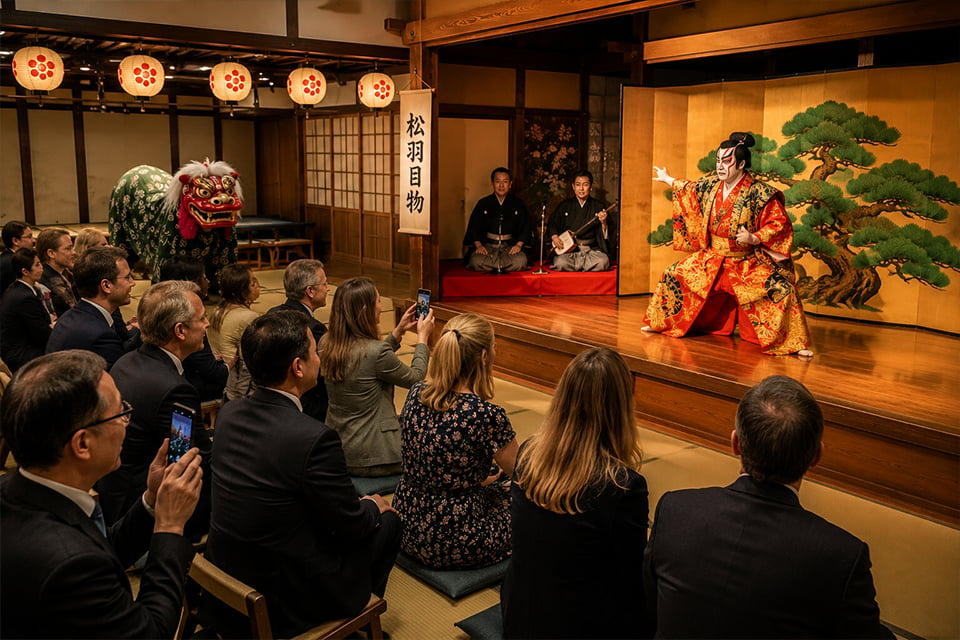
Entertainment and cultural experience fees in Tokyo are usually quoted individually rather than through a standardized public price list. The final cost depends on the performer as well as the production, interpretation, staffing, and venue requirements.
- Performance duration and preparation time
- Number of performers, instructors, and support staff
- Traditional performing arts versus contemporary entertainment
- Performer profile and availability
- Venue restrictions, including sound, movement, staging, and available space
- Interpretation or bilingual support requirements
- Rehearsals, audiovisual materials, and other production needs
Why Venue Rules Can Change the Program: A Lion Dance Example
Venue restrictions can change both the program and the final scope of work. In one MOTENAS JAPAN program for key international conference participants from five European countries, a karate demonstration was initially planned at Palace Hotel Tokyo. Venue regulations made the performance impractical, so Japanese dance and Shishi-mai (lion dance) were proposed as alternatives. The client selected the approximately 20-minute lion dance program.
Language support also required more than literal translation. The English explanation needed to communicate cultural context, including the wordplay between kamu (“to bite”) and kami (“deity”). This is one example of why interpretation requirements can change with the complexity of a cultural program.
Customizing Content for the Client: A Kabuki Example
Customization can add production and staffing requirements beyond the performer fee. In another MOTENAS JAPAN project, a kabuki program was developed for an event with international guests. The lecturer’s content was adjusted in advance to connect elements of kabuki with the client’s corporate philosophy.
For larger events, multiple bilingual staff members may be assigned to support international guests alongside the instructor and performers. MOTENAS JAPAN also handled the production of explanatory video materials, including coordination of the camera crew and performers, bringing these production elements together within the same program.
What to Ask For When Requesting a Quote
Ask for an itemized proposal rather than a performer fee alone. The quote should clarify what is included for performers, rehearsals, interpretation, bilingual staffing, audiovisual production, equipment, transportation, and venue-specific requirements. This makes it easier to compare programs whose production needs may differ even when the performances appear similar.
Need a budget based on your venue, guest profile, and program requirements? Get a tailored quote for your event.
Sample Budget by Event Size
For early-stage planning, a straightforward Tokyo corporate event with venue space, food and beverages, and simple production can reasonably be modeled at around ¥300,000–¥500,000 for 20 guests, ¥600,000–¥1,000,000 for 50 guests, and ¥1,200,000–¥2,000,000 for 100 guests. These are planning estimates rather than package prices, and the final total depends heavily on the venue and event format.
Current 2026 hotel banquet plans help establish a useful benchmark. For example, Tokyo Dome Hotel publishes banquet plans from ¥11,000 per person, while Tokyo Prince Hotel lists plans from ¥15,000 to ¥17,000 per person. These packages can include food, free-flow drinks, venue use, and basic audiovisual equipment, although inclusions differ by property.
| Event Size | Estimated Core Budget | What the Estimate Assumes |
| 20 guests | ¥300,000–¥500,000 | Small meeting or reception space, food and beverages, and basic event setup |
| 50 guests | ¥600,000–¥1,000,000 | Banquet or professional event space, catering, beverages, and basic production |
| 100 guests | ¥1,200,000–¥2,000,000 | Larger event space, catering, beverages, audiovisual requirements, and more complex coordination |
Guest count and total cost do not increase at the same rate. Catering often scales per person, while venue rental, audiovisual equipment, transportation, and production may be fixed or semi-fixed costs. Build the core event budget first, then add these requirements as separate line items.
FAQ
Why do quotes for the same event vary so much?
Quotes vary because suppliers may package the same event requirements differently. One proposal may include venue setup, audiovisual equipment, staffing, transportation, or coordination, while another lists them separately. Compare the scope, exclusions, cancellation terms, and overtime policies rather than evaluating proposals only by their final price.
What’s typically included in a per-person hotel package?
A per-person hotel package may combine meeting space with catering and basic event equipment, but inclusions vary by property and plan. Check whether coffee breaks, audiovisual equipment, Wi-Fi, stationery, setup time, and room rental are included. Reception or banquet packages may use a different pricing structure from meeting packages.
Do the prices above already include tax and service charge?
Not necessarily, so always check whether a published rate is inclusive or exclusive before using it in your budget. Japan’s consumption tax is generally 10%, while hotels and venues may apply a separate service charge. Some packages already include both, whereas other quotations add them to the base amount.
How far in advance should I start budgeting for a Tokyo event?
Start building a working budget as soon as the approximate date, guest count, and event format are known. Earlier budgeting gives you more flexibility when comparing venues and suppliers, particularly during periods of high demand. Keep a contingency for changes in attendance, program requirements, overtime, or additional staffing.
Plan Your Tokyo Event with MOTENAS JAPAN
Once you have a working budget, the next step is to define what your event actually requires. Venue format, guest count, catering, interpretation, transportation, and cultural programming should be considered together rather than priced in isolation.
MOTENAS JAPAN supports international corporate events in Tokyo from planning through on-site operations, including venue selection, food arrangements, interpretation, transportation, and customized programs. This can be particularly useful when your event involves international guests and multiple local suppliers that need to work within one schedule.
Share your expected guest count, preferred dates, event format, and approximate budget range to start building a proposal around your requirements.
Sources
Meeting Package: ANA InterContinental Tokyo – Meeting Package
Venue Pricing Benchmarks: Japan Meetings – Japan Venue Price Bands and Pricing Benchmarks 2025
Cocktail Buffet: Imperial Hotel Tokyo – Cocktail Buffet Plan
Banquet Plan: Tokyo Dome Hotel – Banquet Plan
Japanese Dining: Hotel Chinzanso Tokyo – Japanese Dining Plan
Interpreter Pricing: Osaka Language Solutions – Japanese Interpreter Pricing Snapshot: 2026 Core Rates
Charter Bus Cost: King Tai Travel – Tokyo Private Car Hire: Toyota Coaster
Vehicle Options: Red Rabbit Travel – Vehicle Fleet
Private Car Service Cost: GoWithGuide – How Much Does It Cost to Hire a Private Car Service in Tokyo?
Banquet Party Plan: Tokyo Prince Hotel – Banquet Party Plan

毎月1回以上国内・海外旅行をする旅好きライターです。
フランス・ベトナム一人旅を筆頭に、ひとりで美味しいものを食べながらゆったり旅をするのが好きです。

