





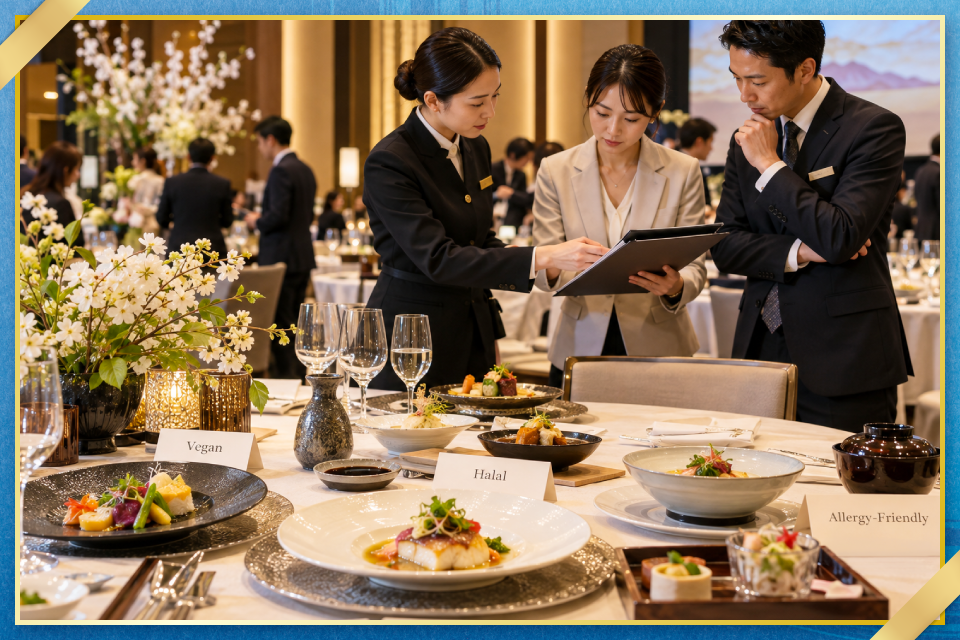

Corporate events in Japan can accommodate dietary requirements such as halal, vegan, vegetarian, gluten-free, and food allergies, but the level of accommodation varies by venue and caterer.
Because Japanese cuisine may contain less obvious ingredients such as dashi, mirin, and cooking sake, organizers should confirm each guest’s specific needs rather than relying only on dietary labels.
The key is confirming exactly what each guest needs and what the venue can provide.
- Collect dietary requirements from attendees
- Check hidden ingredients in Japanese food
- Understand halal-certified and Muslim-friendly options
- Plan for food allergies and cross-contact risks
- Choose between buffet service and individually prepared meals
- Coordinate dietary requirements with venues and caterers
- Manage multiple dietary restrictions at one corporate event
Can Corporate Events in Japan Accommodate Halal, Vegan, and Other Dietary Restrictions?
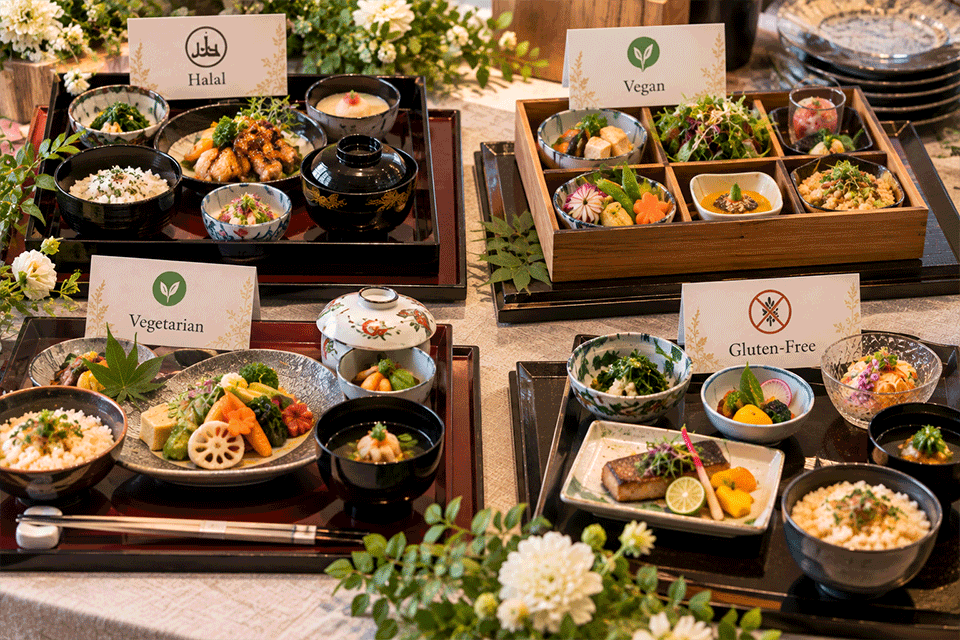
In many cases, yes—but the key issue is the level of accommodation each venue can actually provide. However, available options and the level of accommodation vary by venue, caterer, and the specific requirements of each guest.
Yes—but the Level of Accommodation Varies
Many major hotels, event venues, restaurants, and specialized caterers in Japan can provide suitable meal options or adjust menus for international guests.
However, the level of accommodation varies by venue and by the type of dietary requirement. A venue that can prepare a vegetarian meal, for example, may not necessarily be able to meet strict halal requirements or accommodate a severe food allergy.
This becomes particularly important for large corporate groups or events involving multiple dietary requirements, where meals, service methods, and participant needs must be coordinated in advance.
Availability does not necessarily mean that every level of dietary restriction can be accommodated. Organizers should confirm each venue’s capabilities before finalizing the event plan.

What Dietary Requirements Should You Ask Attendees About?
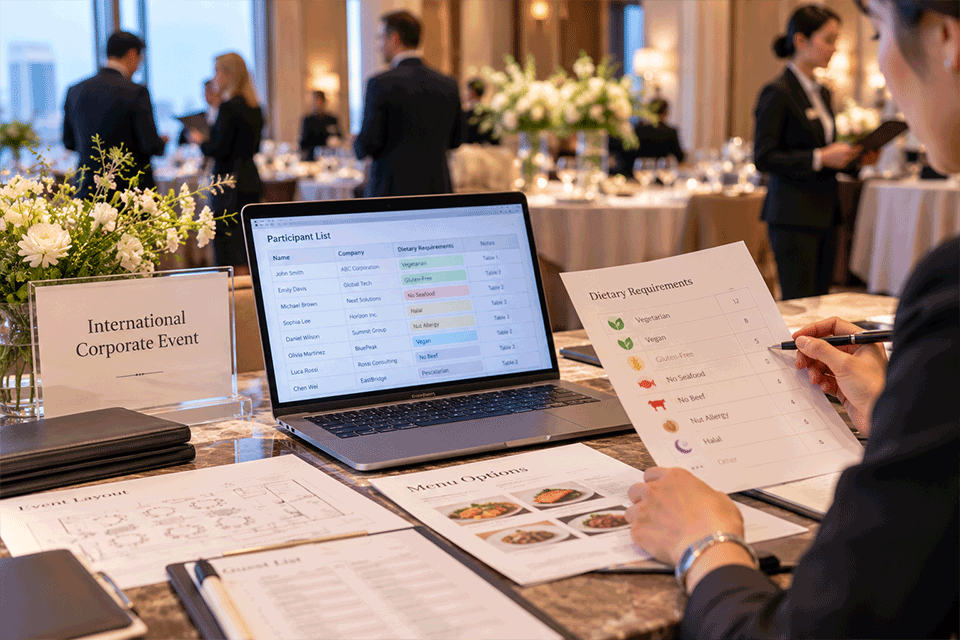
Dietary requirements should be collected as early as possible, ideally during event registration. Rather than asking only whether attendees need a “special meal,” collect enough detail to understand the type and level of restriction for each guest.
Collect Dietary Information at Registration
Include dietary questions directly in the registration form. Common options may include:
- Halal
- Kosher
- Vegetarian
- Vegan
- Pescatarian
- Gluten-free
- Food allergies
- No pork
- No beef
- No alcohol, including alcohol used in cooking
- Other
In addition to checkboxes, provide an “Other / Specific Details” field so attendees can explain requirements that do not fit neatly into a category.
This is particularly important when planning corporate events for large groups, where dietary information from many participants needs to be collected and organized before the event.
Separate Medical Allergies from Religious or Lifestyle Requirements
Do not treat every dietary requirement as the same type of “special meal.” For example, a guest following a vegan diet and a guest with a severe peanut allergy require different types of planning.
For food allergies, ask attendees to specify:
- The exact allergen
- The severity of the allergy
- Whether cross-contact needs to be avoided
This distinction helps organizers understand which requests involve medical risks and which relate to religious, ethical, or lifestyle choices.
Create a Dietary Matrix
For events with multiple dietary requirements, consolidate the information into a dietary matrix.
| Guest | Halal | Vegan | Gluten-Free | Allergy | Other |
| Guest A | ✓ | No cooking alcohol | |||
| Guest B | ✓ | Soy | |||
| Guest C | ✓ |
A centralized matrix makes it easier to see how many different requirements are involved and to identify guests with overlapping needs.
The goal at this stage is to create one clear source of dietary information for the event. Once the requirements have been organized, they can be converted into a detailed brief for the venue or caterer.
Hidden Ingredients in Japanese Food to Check
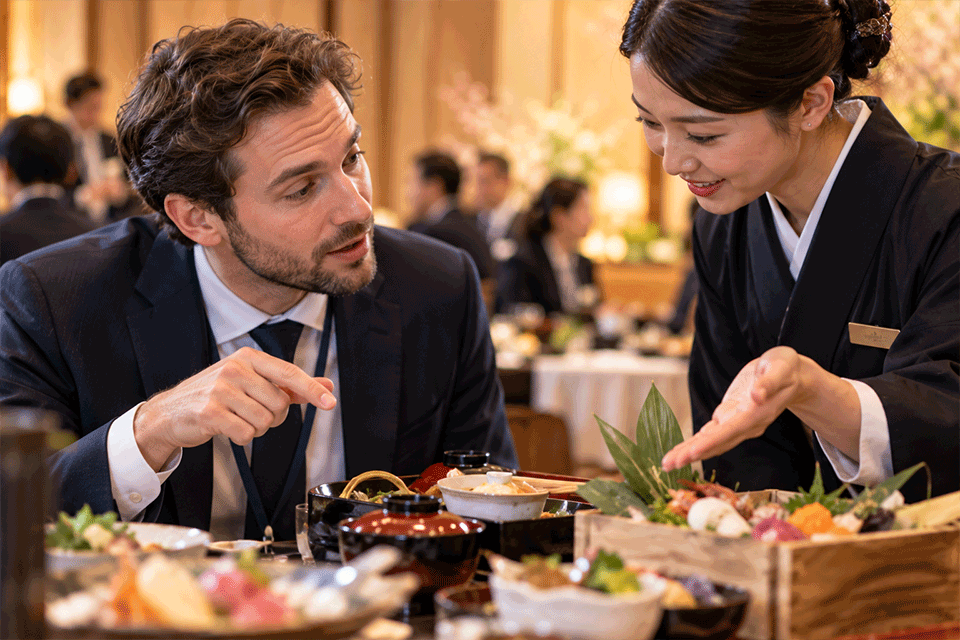
Japanese dishes may contain ingredients that are not obvious from their appearance or menu description. For corporate events, organizers should check not only the main ingredients but also stocks, sauces, seasonings, marinades, dressings, and garnishes.
Ingredients to Check for Halal Guests
For halal guests, ingredients and seasonings that may require confirmation include:
- Mirin
- Cooking sake
- Pork or pork extract
- Lard
- Gelatin
- Non-halal meat
- Alcohol-containing sauces and seasonings
Even dishes that do not visibly contain pork or alcohol may still include them in sauces, stocks, or seasonings. Event planners should therefore confirm the ingredients used in each dish rather than relying only on its name or appearance.
Ingredients to Check for Vegan and Vegetarian Guests
One of the most important hidden ingredients to check is dashi, the stock used as a base for many Japanese dishes. Dashi may contain katsuobushi (dried bonito flakes), niboshi (dried small fish), or other animal-derived ingredients.
Other ingredients to check include:
- Meat stock
- Gelatin
- Egg and dairy
- Fish-based sauces
- Oyster-based sauces
Do not check only the visible ingredients.
This type of detailed confirmation is also important when planning incentive travel in Japan, where meals may be served across multiple restaurants, venues, and activities.
JNTO also notes that some restaurants describing themselves as halal-friendly may not prepare food in a separate halal-only kitchen.
Ingredients to Check for Gluten-Free Guests
For gluten-free guests, ingredients and dishes that may require particular attention include:
- Standard soy sauce
- Wheat-containing soba
- Udon
- Tempura batter
- Barley-containing products
Standard soy sauce commonly contains wheat, so organizers should check the ingredient list when gluten must be avoided. For guests with halal requirements, seasonings such as soy sauce should also be checked individually rather than assuming that all products contain—or do not contain—alcohol.
It is also important to distinguish between a gluten-free preference and a medical requirement, as the level of precaution required may differ.

Halal-Certified vs. Muslim-Friendly: What Event Planners Should Know

“Halal-certified” and “Muslim-friendly” should not be treated as interchangeable terms when planning a corporate event in Japan. The meaning and conditions can vary depending on the certification body or facility, so organizers should first understand what the venue provides and what each guest requires.
“Muslim-Friendly” Does Not Have One Universal Meaning in Japan
The term “Muslim-friendly” does not have one universal meaning across Japan.
For example, the Japan Halal Association distinguishes between Halal Certification and Muslim-Friendly Certification for food service facilities. Under the association’s standards, both certifications require the food served to be halal; a key difference is whether alcoholic beverages may be served in the facility.
Other organizations or venues may use the term differently. Therefore, event planners should not assume that “Muslim-friendly” automatically indicates a particular certification status or set of operating conditions.
For a broader explanation of halal requirements, see What Is Halal? Meaning, Rules, and a Guide for Global Hosts.

Ask What the Guest Actually Requires
Rather than relying on a general label, ask each guest what level of accommodation they actually need.
Questions may include:
- Is formal halal certification required?
- Is halal-certified meat required?
- Must cooking alcohol be excluded?
- Is a shared kitchen acceptable?
- Would the guest be comfortable if alcohol is served elsewhere in the venue?
The answers can differ from guest to guest. Once these requirements are clear, organizers can check whether the venue, restaurant, or caterer can meet them.
The goal is not simply to find a venue labeled “halal” or “Muslim-friendly,” but to match the guest’s requirements with what the venue can actually provide.
How to Handle Food Allergies at Corporate Events in Japan
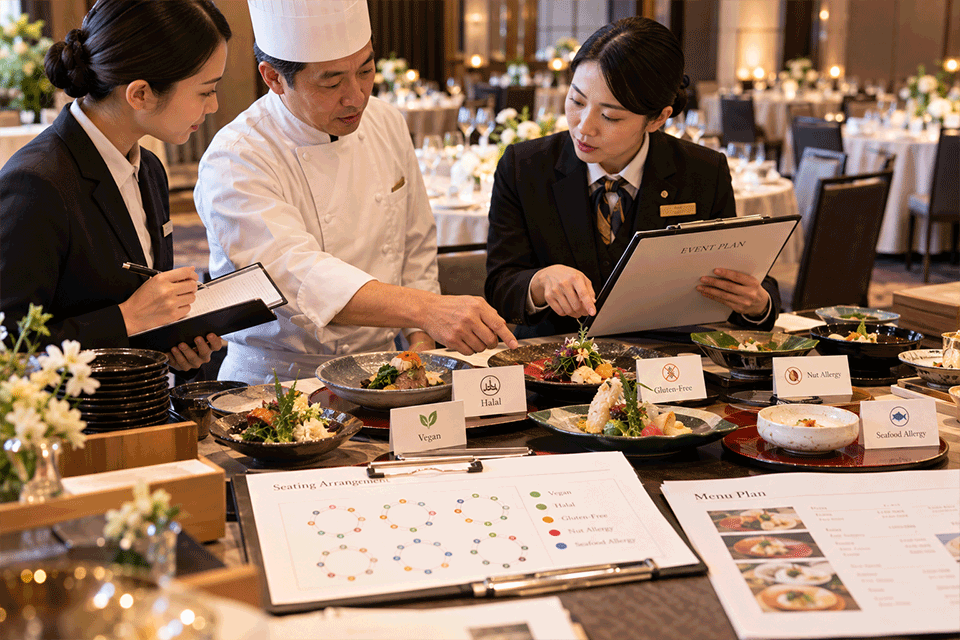
Food allergies require a different level of planning from dietary preferences. Event organizers should understand Japan’s allergen labeling system while also confirming what the venue or caterer can realistically manage in its kitchen.
Understand Japan’s Food Allergy Labeling System
In Japan, nine allergens are currently subject to mandatory labeling on packaged processed foods:
- Shrimp
- Cashew nuts
- Crab
- Walnut
- Wheat
- Buckwheat
- Egg
- Milk
- Peanut
Cashew nuts were added to the mandatory labeling list on April 1, 2026. However, a transition period runs until March 31, 2028, meaning some packaged products may not yet reflect the new requirement.
Importantly, packaged-food allergen labeling rules should not be confused with a guarantee that restaurant or banquet meals are allergen-free.
Ask About Cross-Contact
When discussing food allergies with a venue or caterer, ask how food is prepared and whether cross-contact may occur.
Points to confirm include:
- Shared kitchens
- Shared cooking equipment
- Shared cooking oil
- Shared cutting boards
- Shared preparation surfaces
- Whether ingredients are stored separately
For example, Tobu Hotel Management states that its hotel, restaurant, and banquet kitchens use shared cooking equipment and cooking oil, meaning that trace allergen cross-contact cannot be completely eliminated.
For guests with food allergies, organizers should therefore confirm the kitchen’s limitations rather than assuming that removing an ingredient from a dish eliminates all risk.
Severe Allergies May Require a Different Solution
Some venues may be unable to accommodate guests with severe food allergies.
Grand Hyatt Tokyo, for example, states in its restaurant allergy policy that it does not have a separate allergen-free kitchen and cannot guarantee against the inadvertent introduction of allergens. It also states that it will not be able to serve guests with severe allergic reactions.
If a venue cannot meet a guest’s requirements, organizers should discuss an alternative solution with the venue and guest rather than assuming the meal can be modified safely. Depending on venue policies and circumstances, this may involve exploring options such as a separately arranged meal.
Buffet or Plated Meals: Which Is Better for Dietary Restrictions?
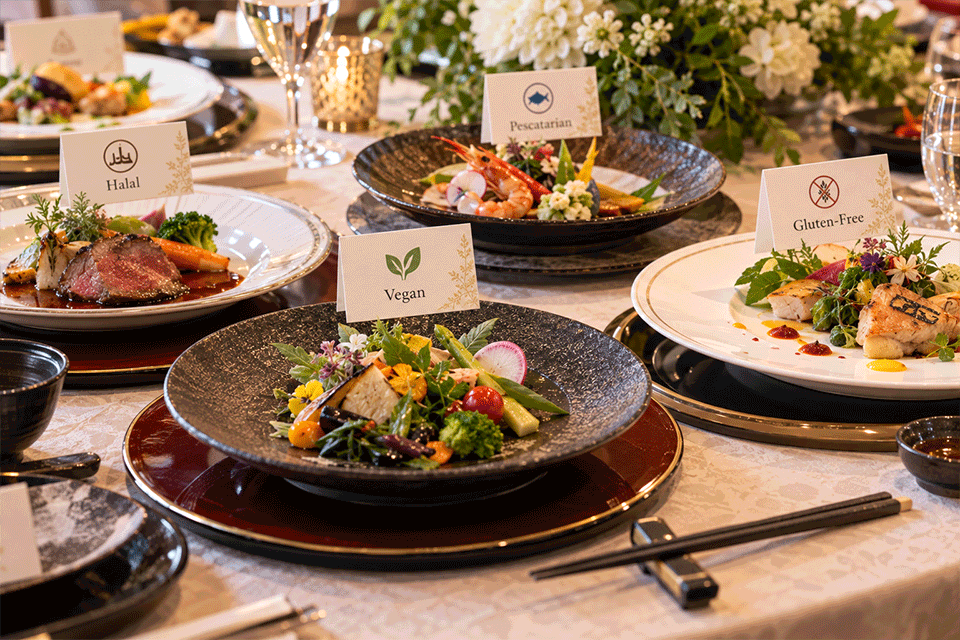
Even when a dish has been prepared appropriately, buffet service can introduce additional cross-contact risks. The best service format depends on the type and severity of dietary requirements, as well as what the venue can safely manage.
Buffets Require Extra Controls
Buffets require careful planning because guests serve themselves and food is placed close together. Serving utensils may be moved between dishes, and ingredients may be difficult for international guests to identify.
Practical measures include:
- Providing dedicated serving utensils for each dish
- Clearly labeling dietary-specific dishes
- Displaying specific allergen information where possible
- Positioning dishes to reduce accidental mixing with neighboring foods
- Assigning staff who can answer guests’ questions
Tobu Hotel Management, for example, notes that some buffet-style outlets cannot accommodate food allergies, so organizers should confirm the venue’s policy in advance.
When Individually Prepared Meals May Be Better
Individually prepared meals may be more suitable for guests with:
- Severe food allergies
- Multiple overlapping restrictions
- Strict halal requirements
- Highly individualized requests
Depending on the event, options may include plated meals or bento boxes.
However, plated does not automatically mean allergen-free. The preparation environment and the venue’s ability to meet the guest’s specific requirements still need to be confirmed.
Use Clear Food Labels
Clear labeling helps guests understand what is being served and identify dishes that may meet their requirements.
Useful labels may include:
- Vegan
- Contains: Wheat, Soy
- Halal-certified
- Muslim-friendly (with a note explaining what this means at the venue)
Avoid relying only on vague terms such as “allergy-friendly.” Labels should provide specific information wherever possible so guests can make informed decisions based on their individual requirements.
What Information Should You Give the Venue or Caterer?
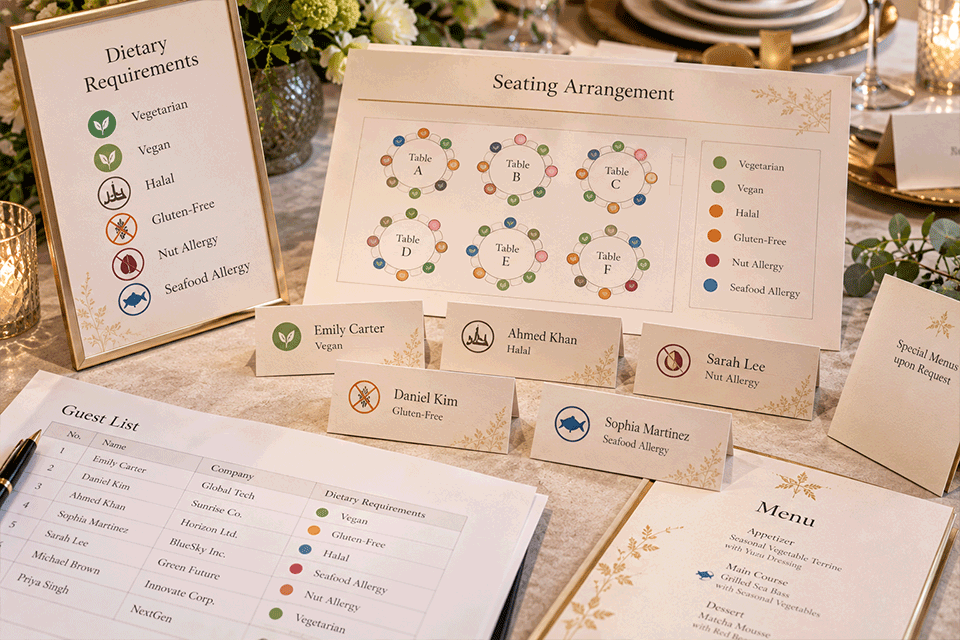
Once attendee requirements have been collected, the next step is to turn that information into clear instructions for the venue or caterer. Do not rely only on verbal conversations or broad labels such as “halal,” “vegan,” or “allergy-friendly.”
Turn Attendee Information into a Written Dietary Brief
Convert the attendee information collected at registration into a written dietary brief. Depending on the event, this may include:
- Guest names or headcount
- Exact dietary restriction
- Specific allergen
- Required accommodation level
- Cross-contact requirements
- Certification requirement
- Whether vegetarian guests eat eggs or dairy products
- Whether gluten-free is a medical requirement
- Service format
- Event date and timing
The purpose is to give the venue one organized source of information rather than sending dietary requests across multiple emails or conversations.
Ask the Venue to Confirm What It Can Provide
Sending the brief is only the first step. Ask the venue or caterer to confirm in writing what it can and cannot provide.
The process should be:
Organizer → Venue / Caterer → Written Confirmation → Organizer
Confirmation may cover ingredients, preparation methods, cross-contact limitations, certification status and requirements, and service methods.
If the venue cannot meet a particular requirement, clarify the limitation before the menu and event arrangements are finalized.
Assign One Point of Contact
Designate one point of contact on the organizer’s side to manage dietary communication.
This person can consolidate questions from guests and coordinate confirmations with the venue or catering team. Keeping communication centralized helps prevent different versions of dietary information from being shared among guests, planners, venue staff, and catering teams.
The goal is to ensure that the requirements collected from attendees match what the venue has actually confirmed it can provide.
Need help confirming dietary requirements with Japanese venues?
Ingredient checks and kitchen confirmations with Japanese venues and restaurants are often handled in Japanese. MOTENAS JAPAN can coordinate dietary requirements with venues, restaurants, and caterers on your behalf as part of broader corporate event planning, along with bilingual staff and on-site operations.
How Far in Advance Should Dietary Restrictions Be Confirmed?

Dietary requirements should be collected early and confirmed with the venue before menus and service arrangements are finalized. There is no single deadline that applies to every corporate event in Japan.
Start at Registration
Begin collecting dietary requirements during event registration rather than waiting until the menu is being finalized.
Early collection gives organizers more time to identify requests that may require additional coordination with the venue, restaurant, or caterer.
Follow the Venue’s Own Deadline
Each venue or caterer may have its own deadline for dietary requests.
For example, Tobu Hotel Management asks guests to consult about meal arrangements at least one week before the date of use. This should not be treated as a standard deadline across Japan.
Deadlines vary by venue, caterer, group size, and complexity. Always check the specific policy of the venue being used.
Discuss Complex Requirements Earlier
Some dietary requirements may require more coordination and should be discussed as early as possible. Examples include:
- Large groups
- Multiple dietary restrictions
- Severe food allergies
- Halal-certified meals
- External caterers
This is especially important when choosing a large event venue in Tokyo, such as a ballroom for a 300-guest gala dinner.
The more complex the dietary requirements, the earlier organizers should begin coordinating with the venue or caterer.
How to Manage Multiple Dietary Restrictions at One Event

International corporate events may involve several dietary requirements at the same time. The goal is to simplify meal planning where appropriate without overlooking the individual needs of each guest.
Consolidate Requirements Where Appropriate
In some cases, one meal may safely meet several dietary requirements. When the venue confirms that this is possible, consolidating suitable meals can simplify menu planning and service operations.
However, organizers should not combine dietary categories simply for operational convenience. Each guest’s actual requirements should remain the starting point, particularly when medical allergies or strict religious requirements are involved.
Do Not Treat Dietary Labels as Safety Guarantees
Dietary labels describe certain characteristics of a meal, but they do not automatically address other restrictions.
For example:
- Vegan ≠ nut-free
- Gluten-free ≠ allergy-safe
- Muslim-friendly ≠ automatically acceptable to every Muslim guest
Guests with medical allergies should not be grouped with lifestyle or religious requests simply because one menu appears to satisfy both.
When several dietary requirements overlap, confirm the individual conditions rather than relying on a single label.
Ask what the guest actually needs.
How MOTENAS JAPAN Supports Dietary Requirements for Corporate Events
Dietary planning works best when it is coordinated alongside the venue, program, and on-site operations from the beginning.
Dietary Requirements as Part of End-to-End Event Planning
Through its MICE and incentive travel services, MOTENAS JAPAN coordinates specialized dietary requirements such as halal and vegan as part of broader event planning.
This can include coordinating with venues, restaurants, and caterers while also managing elements such as venue selection, itineraries, transportation, bilingual staff, and on-site support.
By considering dietary needs alongside the overall program, organizers can identify potential limitations before key event arrangements are finalized.
Case Studies: Dietary Coordination for International Guests
MOTENAS JAPAN’s published case studies include examples of dietary coordination for international corporate guests.
For a corporate VIP kabuki program for overseas executives, MOTENAS JAPAN also handled the dinner reception that followed, including seating coordination and menu adjustments for food allergies in close collaboration with the restaurant. Staffing was tailored to the scale of the event, allowing the client to focus on hosting its guests.
In another program for a global pharmaceutical corporation, MOTENAS JAPAN organized an eight-day program for 15 executive board members and their families from Europe and the United States. The client’s testimonial specifically highlighted the detailed attention given to dietary restrictions.
Local Knowledge of Japanese Ingredients
Understanding ingredients such as dashi, mirin, and cooking sake allows MOTENAS JAPAN to ask venues and restaurants more specific questions—not just whether a dish contains meat, but how its stock, sauces, and seasonings are prepared.
Dietary planning should be integrated into venue and program design rather than treated as a last-minute catering request.
Frequently Asked Questions
Can Corporate Events in Japan Accommodate Halal Food?
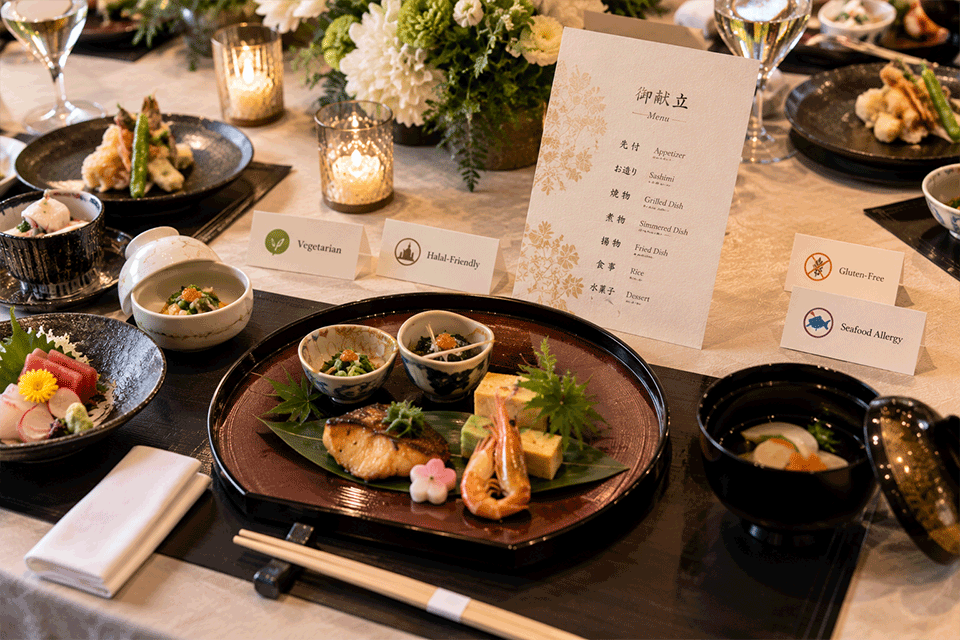
Yes. Some hotels, restaurants, event venues, and caterers in Japan can accommodate halal requirements. However, availability and conditions vary, so organizers should confirm certification status and requirements, cooking alcohol, ingredients, and kitchen conditions based on each guest’s needs.
Is Halal Certification Necessary for a Corporate Event in Japan?
Not necessarily. There are no legal regulations on halal in Japan, and several different organizations issue halal certification. Event planners should ask Muslim guests whether formal certification is required and confirm the appropriate level of accommodation with the venue or caterer.
There are no legal regulations on halal in Japan, and several different organizations issue halal certification.
Does Soy Sauce Contain Alcohol or Wheat?
Often, yes. Standard Japanese soy sauce is brewed with wheat, and many products contain alcohol, either from fermentation or added as a preservative. Guests who avoid gluten or alcohol should confirm the specific product the kitchen uses.
Is Japanese Food Generally Vegan-Friendly?
Not necessarily. Even dishes that appear plant-based may contain dashi made with bonito flakes, dried fish, or other animal-derived ingredients. Organizers should check stocks, sauces, seasonings, and garnishes rather than judging a dish only by its visible ingredients.
How Should Dietary-Restricted Meals Be Labeled at a Buffet?
Use clear, specific labels such as “Vegan,” “Contains: Wheat, Soy,” “Halal-certified,” or “Muslim-friendly,” as appropriate. Avoid relying only on vague descriptions such as “allergy-friendly,” which may not provide enough information for guests with specific dietary requirements.
What Should I Tell a Venue About a Guest With a Severe Food Allergy?
Tell the venue the exact allergen, severity of the allergy, and relevant cross-contact requirements. Ask the venue or caterer to confirm in writing whether it can accommodate those requirements and what limitations may apply to its kitchen or food preparation.
Plan Early for Dietary Requirements at Corporate Events in Japan
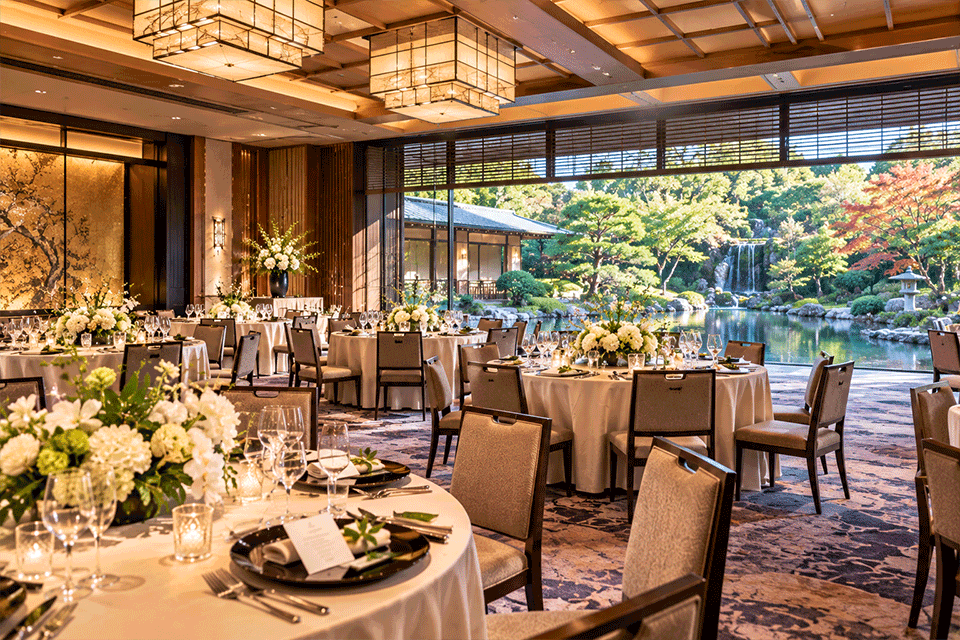
Japan can accommodate diverse dietary requirements at corporate events, but successful planning depends on specificity. Instead of relying only on labels such as halal, vegan, gluten-free, or allergy-friendly, organizers should understand exactly what each guest needs and confirm what the venue can provide.
A practical framework is Collect → Clarify → Confirm → Coordinate → Serve: collect requirements early, clarify individual needs, confirm venue capabilities, coordinate the details, and ensure the agreed arrangements are reflected in the final service.
By integrating dietary planning into the event from the beginning, organizers can create a smoother experience for both international guests and local venues.
Planning a corporate event in Japan?
Share your event dates, estimated headcount, venue or area, and a summary of your guests’ dietary requirements. MOTENAS JAPAN can coordinate venues, catering, bilingual staff, and on-site operations as one integrated plan.

毎月1回以上国内・海外旅行をする旅好きライターです。
フランス・ベトナム一人旅を筆頭に、ひとりで美味しいものを食べながらゆったり旅をするのが好きです。

